Test Index
CBSE Class 12 Physics 2016 Delhi Set 1 Paper
© examsnet.com
Question : 17 of 26
Marks:
+1,
-0
How are em waves produced by oscillating charges? Draw a sketch of linearly polarized em waves propagating in the Z-direction. Indicate the directions of the oscillating electric and magnetic fields. OR Write Maxwell's generalization of Ampere's Circuital Law. Show that in the process of charging a capacitor, the current produced within the plates of the capacitor is Where is the electric flux produced during charging of the capacitor plates.
Solution:
Production of em waves Drawing of sketch of linearly polarized em waves Indication of directions of oscillating electric and magnetic fields A charge oscillating with some frequency, produces an oscillating electric field in space, which in turn produces an oscillating magnetic field perpendicular to the electric field, this process goes on repeating, producing em waves in space perpendicular to both the fields. 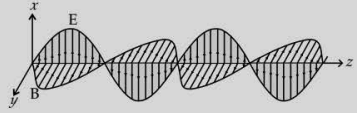 Directions of and are perpendicular to each other and also perpendicular to direction of propagation of em waves. ORMaxwell's generalization of Ampere's Circuital lawShowing that current produced, within the plates of a capacitor is Ampere's circuital law is given by as But for a circuit containing capacitor, during its charging / discharging the current within the plates of the capacitor varies, (producing displacement current ). Therefore, the above equation, as generalized by Maxwell, is given as During the process of charging of capacitor, electric flux between the plates of capacitor changes with time, which produces the current within the plates of capacitor. This current, being proportional to , we have
© examsnet.com
Go to Question: