Test Index
CBSE Class 12 Physics 2016 Delhi Set 1 Paper
© examsnet.com
Question : 26 of 26
Marks:
+1,
-0
(i) Define the term drift velocity. (ii) On the basis of electron drift, derive an expression for resistivity of a conductor in terms of number density of free electrons and relaxation time. On what factors does resistivity of a conductor depend? (iii) Why alloys like constantan and manganin are used for making standard resistors? OR (i) State the principle of working of a potentiometer. (ii) In the following potentiometer circuit is a uniform wire of length and resistance . Calculate the potential gradient along the wire and balance length .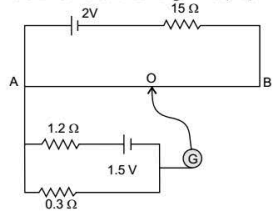
Solution:
(i) Definition of drift velocity (ii) Derivation of expression of resistivity Factors affecting resistivity (iii) Reason of using constantan and manganin (i) Average velocity acquired by the electrons in the conductor in the presence of external electric field. [Alternatively: where is the relaxation time.] (ii) We have , where is potential across the length of the conductor ....(i) Also, .....(ii) Comparing (i) and (ii), Resistivity of the material of a conductor depends on the relaxation time, i.e., temperature and the number density of electrons. (iii) Because constantan and manganin show very weak dependence of resistivity on temperature. OR (i) Working principle of potentiometer (ii) Calculation of potential gradient and balance length (i) When constant current flows through a conductor of uniform area of cross section, the potential difference, across a length of the wire, is directly proportional to that length of the wire. (Provided current and area are constant] (ii) Current flowing in the potentiometer wire Potential difference across the two ends of the wire Hence potential gradient Current flowing in the circuit containing experimental cell, Hence, potential difference across length of the wire
© examsnet.com
Go to Question: