Test Index
CBSE 2023 Class 12 English Delhi Set 1 Paper
Show Para
Read the passage given below: (1) Fast-Moving Consumer Goods (FMCG) are products that sell quickly at relatively low cost. FMCG is the fourth-largest sector in the Indian economy. There are three main segments in the sector - food andbeverages, which accounts for of the sector; healthcare, which accounts for of the share; and household and personal care, which accounts for the remaining share. The urban segment contributes to about of the revenue share,while the rural segment accounts for . Rise in rural consumption will drive the FMCG market. The Indian processed food market is projected to expand to US 470 billion by 2025, up from US 263 billion in 2019-20. (2) TheIndian FMCG industry grew by in 2021, a 9-year high, despite nationwide lockdowns, supported by consumption-led growth and value expansion from higher product prices, particularly for staples. Real household spending is projected to increase after 2021 , after a decrease of in 2020 due to the economic impact of the pandemic. Price increase across product categories will offset the impact of rising raw material prices, along with volume growth and resurgence of demand for discretionaryitems. (3) The FMCG sector has received good investments and support from the Government in the recent past. The sector witnessed healthy FDI inflows from April 2000-March 2022. Furthermore, as per the Union Budget 2022-23, a substantial amounthas been allocated to the Department of Consumer Affairs, an increased amount has been allocated to the Department of Food and Public Distribution. In 2021-22, the Government approved Production-Linked Incentive Scheme for Food Processing Industry (PLISFPI)with an outlay of a larger amount to help Indian brands of food products in the international markets. (4) The Government's Production-Linked Incentive (PLI) Scheme gives companies a major opportunity to boost exports. The future outlook ofthe FMCG rural sector looks on track now. Rural consumption has increased, led by a combination of increasing income and higher aspiration levels. There is an increased demand for branded products in rural India. The growth of organised sector in FMCGis expected to rise with an increased level of brand consciousness, augmented by the growth in modern retail.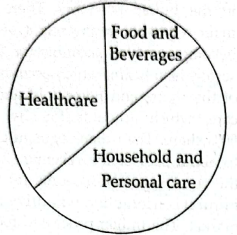
| Table I. FMCG Products |
|---|
| 1. Processed foods : Cheese products, cereals |
| 2. Prepared meals : Ready-to-eat meals |
| 3. Beverages: Bottled water, aerated drinks, and juices |
| 4. Baked goods : Biscuits, bread |
| 5. Fresh foods, frozen foods, and dry goods: Fruits, vegetables, milk, butter, frozen food, and nuts |
| 6. Medicines : Aspirin, pain relievers, and over-the-counter medication that can be purchased without a prescription |
| 7. Cleaning products : Baking soda, washing powder |
| 8. Cosmetics and toiletries : Beauty products, soaps, toothpastes |
| 9. Office supplies : Pens, pencils |
© examsnet.com
Question : 14 of 73
Marks:
+1,
-0
Complete the sentence based on the following statement: The Indian FMCG industry grew by in 2021, a 9-year high, despite nationwide lockdowns because _______.
Solution:
it was supported by consumption-led growth and value expansion from higher product prices, particularly for staples.
© examsnet.com
Go to Question: