Test Index
CBSE Class 10 Science 2019 Outside Delhi Set 1
© examsnet.com
Question : 20 of 27
Marks:
+1,
-0
(a) How will you infer with the help of an experiment that the same current flows through every part of a circuit containing three resistors in series connected to a battery?(b) Consider the given circuit and find the current flowing in the circuit and potential difference across the resistor when the circuit is closed.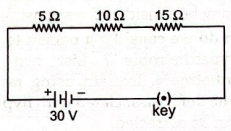 OR(a) Three resistors and are connected in parallel and the combination is connected to a battery, ammeter, voltmeter and key. Draw suitable circuit diagram and obtain an expression for the equivalent resistance of the combination of the resistors.(b) Calculate the equivalent resistance of the following network: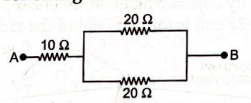
Solution:
(a) Let three resistors and are connected in series which are also connected with a battery, an ammeter and a key as shown in figure. 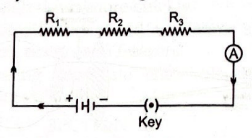 When key is closed, the current starts flowing through the circuit. Take the reading of ammeter. Now change the position of ammeter to anywhere in between the resistors and take its reading. We will observe that in both the cases reading of ammeter will be same showing same current flows through every part of the circuit above. (b) Given,Total resistance,and are connected in series]Potential difference, Current in the circuit, ?From Ohm's law. Current flowing in the circuit Potential difference across resistors OR (a) Let and are three resistance connected in parallel to one another and is the equivalent resistance of the circuit. A battery of V volts has been applied across the ends of this combination. When the switch of the key is closed, current I flows in the circuit such that,
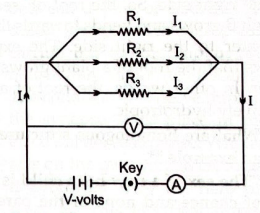 From Ohm's law, ...(i)...(ii)...(iii)...(iv)...(v) Putting the values of and in equation (v), (b) Let is the equivalent resistance of resistors connected in parallel.
 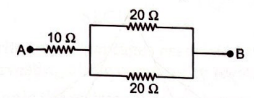 Equivalent resistance of resistors in parallel:Now, equivalent circuit becomes.
 and are connected in series. Equivalent resistance of the circuit
© examsnet.com
Go to Question: