Test Index
CBSE Class 10 Science 2020 Delhi Set 2
© examsnet.com
Question : 8 of 10
Marks:
+1,
-0
(a) State the relation correlating the electric current flowing in a conductor and the voltage applied across it. Also draw a graph to show this relationship.(b) Find the resistance of a conductor if the electric current flowing through it is 0.35 A when the potential difference across it is .
Solution:
(a) The ohm's law states that the current carrying in a conductor is directly proportional to the voltage applied across the ends of the conductor, keeping the resistance constant. 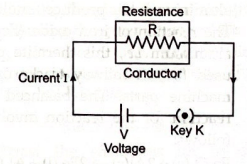 Circuit DiagramAccording to ohm's law; Mathematically; where, Voltage applied in volts Current flowing in circuit in amperes. Resistance of conductor (proportionality constant) Graphically; slope of will determine resistance of conductor.
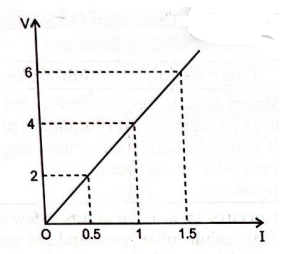 (b) Given, current flowing through conductorPotential difference across conductor We know, according to ohm's law, Therefore, resistance of conductor is 4 ohms.
© examsnet.com
Go to Question: