Test Index

CBSE Class 12 Chemistry 2013 Solved Paper

© examsnet.com
Question : 28 of 30
Marks: +1, -0
(a) A reaction is second order in A and first order in BB.
(i) Write the differential rate equation.
(ii) How is the rate affected on increasing the concentration of A three times?
(iii) How is the rate affected when the concentrations of both A and B are doubled?
(b) A first order reaction takes 4040 minutes for 30%30\% decomposition. Calculate t1/2t_{1/2} this reaction.
(( Given log1.428=0.1548)\log 1.428=0.1548)
OR
(a) For a first order reaction, show that time required for 99%99\% completion is twice the time required for the completion of 90%90\% of reaction.
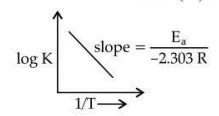
(b) Rate constant ' kk ' of a reaction varies with temperature ' TT ' according to the equation:
logk=logAEa2.303R(1T)\log k = \log A - \frac{E_a}{2.303 R} \left( \frac{1}{T} \right)
Where EaE_a is the activation energy. When a graph is plotted for logk\log k Vs. 1T\frac{1}{T}, a straight line with a slope of 4250K-4250\,\mathrm{K} is obtained. Calculate ' EaE_a ' for the reaction. (R=8.314JK1mol1)(\mathrm{R}=8.314\,\mathrm{J\,K}^{-1}\,\mathrm{mol}^{-1})
Solution:  
(a) (i) Differential Rate equation:
dxdt=K[A][B]2\frac{dx}{dt}=K[A][B]^2
(ii) Let [A]=a,[B]=b[A]=a,[B]=b
if [B][B] increases three times
[B]=3b[B]=3b
∴ Rate =K[A][B]2=K[A][B]^2
Rate1=K×a×b2      .......(i)\text{Rate}_1 = K \times a \times b^2 \;\;\; \text{.......}(i)
Rate2=K×a×(3b)2      .......(ii)\text{Rate}_2 = K \times a \times (3b)^2 \;\;\; \text{.......}(ii)
From eqn (i) and eqn (ii)
Rate 2Rate 1=K×a×(3b)2K×a×b\frac{\text{Rate }_2}{\text{Rate }_1} = \frac{K \times a \times (3b)^2}{K \times a \times b}
rate 2=9×_2 = 9 \times Rate 1_1
\because The rate becomes 9 times when the concentration of B is tripled.
(iii) If [A][A] and [B][B] is doubled then [A]=2a,[B]=2b[A]=2a,[B]=2b
Rate1=K×a×b2      .......(i)\text{Rate}_1 = K \times a \times b^2 \;\;\; \text{.......}(i)
Rate2=K×(2a)×(2b)2      .......(ii)\text{Rate}_2 = K \times (2a) \times (2b)^2 \;\;\; \text{.......}(ii)
From eqn (i) and eqn (ii)
Rate 2Rate 1=K×(2a)×(2b)2K×a×b2=8\frac{\text{Rate }_2}{\text{Rate }_1} = \frac{K \times (2a) \times (2b)^2}{K \times a \times b^2} = 8
Rate 2=8×_2 = 8 \times Rate 1_1
\because The rate becomes eight times when the concentration of both A and B is doubled.
OR
(i) For the first order reaction:
t=2.303Klogaaxt = \frac{2.303}{K} \log \frac{a}{a-x}
t99%=2.303Klog1001t_{99\%} = \frac{2.303}{K} \log \frac{100}{1}
=2.303Klog100= \frac{2.303}{K} \log 100
=2.303×2K= \frac{2.303 \times 2}{K}
=4.606K= \frac{4.606}{K}
and t90%=2.303Klog10010t_{90\%} = \frac{2.303}{K} \log \frac{100}{10}
=2.303Klog10= \frac{2.303}{K} \log 10
=2.303K= \frac{2.303}{K}
t99%t90%=2\because \frac{t_{99\%}}{t_{90\%}} = 2
t99%=2×t90%t_{99\%} = 2 \times t_{90\%}
(b) logK=Ea2.303R(1T)\log K = -\frac{E_a}{2.303 R} \left( \frac{1}{T} \right)
Ea2.303R=4250-\frac{E_a}{2.303 R} = -4250
Ea=4250×2.303×8.314E_a = 4250 \times 2.303 \times 8.314
=81375Jmol1= 81375\,\mathrm{J\,mol}^{-1}
=81.375kJmol1= 81.375\,\mathrm{kJ\,mol}^{-1}
© examsnet.com
Go to Question: