Test Index

CBSE Class 12 Chemistry 2016 Outside Delhi Set 1 Solved Paper

© examsnet.com
Question : 26 of 26
Marks: +1, -0
(a) Write the structures of A and B in the following reactions :
(i) CH3COClH2, PdBaSO4AH2NOHB.\mathrm{CH}_3\,\mathrm{COCl} \xrightarrow{\mathrm{H}_2,\ \mathrm{Pd}-\mathrm{BaSO}_4}{A} \xrightarrow{\mathrm{H}_2\mathrm{N}-\mathrm{OH}}{B}.
(ii) CH3MgBr2H3O+1.CO2APCl5B\mathrm{CH}_3\mathrm{MgBr} \xrightarrow[2 \cdot \mathrm{H}_3\mathrm{O}^+]{\mathrm{1.CO}_2}{A} \xrightarrow{\mathrm{PCl}_5}{B}.
(b) Distinguish between :
(i) C6H5COCH3\mathrm{C}_6\mathrm{H}_5-\mathrm{COCH}_3 and C6H5CHO\mathrm{C}_6\mathrm{H}_5-\mathrm{CHO},
(ii) CH3COOH\mathrm{CH}_3\mathrm{COOH} and HCOOH\mathrm{HCOOH}.
(c) Arrange the following in the increasing order of their boiling points :
CH3CHO,CH3COOH,CH3CH2OH\mathrm{CH}_3\mathrm{CHO}, \mathrm{CH}_3\mathrm{COOH}, \mathrm{CH}_3\mathrm{CH}_2\mathrm{OH}.
OR
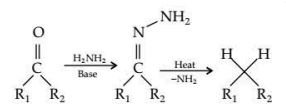
(a) Write the chemical reaction involved in WolffKishner reduction.
(b) Arrange the following in the increasing order of their reactivity towards nucleophilic addition reaction :
C6H5COCH3,CH3CHO,CH3COCH3\mathrm{C}_6\mathrm{H}_5\mathrm{COCH}_3, \mathrm{CH}_3-\mathrm{CHO}, \mathrm{CH}_3\mathrm{COCH}_3
(c) Why carboxylic acid does not give reactions of carbonyl group ?
(d) Write the product in the following reaction.
CH3CH2CH=CHCH2CN\mathrm{CH}_3\mathrm{CH}_2\mathrm{CH}=\mathrm{CH}-\mathrm{CH}_2\mathrm{CN}   2.  H2O  1.  (iBu)2AlH  ?\xrightarrow[\;\text{2.}\;\mathrm{H}_2\mathrm{O}]{\;\text{1.}\;(\mathrm{i}-\mathrm{Bu})_2\mathrm{AlH}}\;\text{?}
(e) A and B are two functional isomers of compound C3H6O\mathrm{C}_3\mathrm{H}_6\mathrm{O}. On heating with NaOH\mathrm{NaOH} and I2\mathrm{I}_2 isomer BB forms yellow precipitate of iodoform whereas isomer A does not form any precipitate. Write the formulae of AA and BB.
Solution:  
(a) (i) CH3COCIH2, PdBaSO4\mathrm{CH}_3\mathrm{COCI} \xrightarrow{\mathrm{H}_2,\ \mathrm{Pd}-\mathrm{BaSO}_4} CH3CHO[A] AcetaldehydeH2NOH\underset{[A]\ \text{Acetaldehyde}}{\mathrm{CH}_3\mathrm{CHO}} \xrightarrow{\mathrm{H}_2\mathrm{N}-\mathrm{OH}} CH3CH=NOH[B] Acetaldoxime\underset{[B]\ \text{Acetaldoxime}}{\mathrm{CH}_3-\mathrm{CH}=\mathrm{N}-\mathrm{OH}}
(ii) CH3MgBr2H3O+1.CO2CH3COOH\mathrm{CH}_3\mathrm{MgBr} \xrightarrow[2 \cdot \mathrm{H}_3\mathrm{O}^+]{\mathrm{1.CO}_2}{\mathrm{CH}_3\mathrm{COOH}} PCl5CH3COCI+HCl+POCl3\xrightarrow{\mathrm{PCl}_5}{\mathrm{CH}_3\mathrm{COCI}+\mathrm{HCl}+\mathrm{POCl}_3}
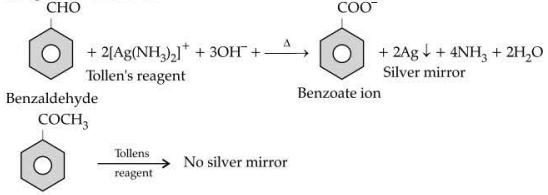
(b) (i) C6H5CHO\mathrm{C}_6\mathrm{H}_5\mathrm{CHO} being an aldehyde reduces Tollens' reagent to shining silver mirror whereas C6H5COCH3\mathrm{C}_6\mathrm{H}_5\mathrm{COCH}_3 being a ketone does not.
(ii) HCOOH\mathrm{HCOOH} gives silver mirror test with Tollens' reagent whereas ethanoic acid does not.
  HCOOH+2[Ag(NH3)2]++2OH\;\mathrm{HCOOH}+2[\mathrm{Ag}(\mathrm{NH}_3)_2]^++2\mathrm{OH}^- 2Ag+2H2O+CO2+4NH3\rightarrow 2\mathrm{Ag}\downarrow+2\mathrm{H}_2\mathrm{O}+\mathrm{CO}_2+4\mathrm{NH}_3
  CH3COOH  reagent  Tollens  No silver mirror\;\mathrm{CH}_3\mathrm{COOH} \xrightarrow[\;\text{reagent}\;]{\text{Tollens}}\;\text{No silver mirror}
OR(a)
(b) C6H5COCH3<CH3COCH3\mathrm{C}_6\mathrm{H}_5\mathrm{COCH}_3 < \mathrm{CH}_3-\mathrm{COCH}_3 <CH3CHO< \mathrm{CH}_3-\mathrm{CHO}
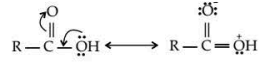
(c) Carboxylicacids do not give reactions of carbonyl groups as it enters into resonance with lone pair of - COOH\mathrm{COOH} groups thereby making the carbon atoms less electrophilic.
(d) CH3CH2CH=CHHex-3-enenitrileCH2CN\underset{\text{Hex-3-enenitrile}}{\mathrm{CH}_3\mathrm{CH}_2\mathrm{CH}=\mathrm{CH}} - \mathrm{CH}_2\mathrm{CN}   2.  H2O  1.  (iBu)2AlHCH3CH2CH\xrightarrow[\;\text{2.}\;\mathrm{H}_2\mathrm{O}]{\;\text{1.}\;(\mathrm{i}-\mathrm{Bu})_2\mathrm{AlH}}{\mathrm{CH}_3\mathrm{CH}_2\mathrm{CH}} =CHCH2COHHex-3-enal= \mathrm{CH} - \underset{\text{Hex-3-enal}}{\mathrm{CH}_2 - \overset{\mathrm{O}}{\overset{\parallel}{\mathrm{C}}} - \mathrm{H}}
(e) CH3CH2CHOPropanal [A]+NaOH+I2\underset{\text{Propanal [A]}}{\mathrm{CH}_3\mathrm{CH}_2\mathrm{CHO}} + \mathrm{NaOH} + \mathrm{I}_2 \rightarrow No yellow precipitate
CH3COCH3Acetone [B]+3NaOH+4I2Δ\underset{\text{Acetone [B]}}{\mathrm{CH}_3 - \overset{\mathrm{O}}{\overset{\parallel}{\mathrm{C}}} - \mathrm{CH}_3} + 3\mathrm{NaOH} + 4\mathrm{I}_2 \xrightarrow{\Delta} CHI3+3NaIIodoform (Yellow precipitate)+CH3COONa+3H2O\underset{\text{Iodoform (Yellow precipitate)}}{\mathrm{CHI}_3 + 3\mathrm{NaI}} + \mathrm{CH}_3\mathrm{COONa} + 3\mathrm{H}_2\mathrm{O}
© examsnet.com
Go to Question: