Test Index
CBSE Class 12 Chemistry 2017 Outside Delhi Set 1 Solved Paper
© examsnet.com
Question : 13 of 26
Marks:
+1,
-0
(a) What type of isomerism is shown by the complex ? (b) Why is paramagnetic while is diamagnetic ? (Atomic number of ) (c) Why are low spin tetrahedral complexes rarely observed?
Solution:
(a) Linkage isomerism is shown by the complex (b) contains ion having configuration. Ground state is a weak field ligand. Hence outer -and -orbitals are used in hybridization.
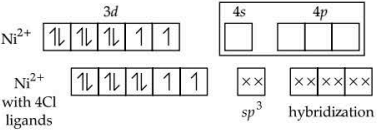 It has two unpaired electrons hence it is paramagnetic whereas contains configuration
 is a strong field ligand hence -electrons will shift to -orbital making -orbital vacant.
  The complex has all paired electrons hence it is diamagnetic.(c) In tetrahedral complexes, hybridization occurs. The orbitals are untouched, so unpaired electrons are available always which give high spins. Therefore, low spin tetrahedral complexes are formed rarely.
© examsnet.com
Go to Question: