Test Index
CBSE Class 12 Chemistry 2020 Delhi Set 1 Solved Paper
© examsnet.com
Question : 36 of 37
Marks:
+1,
-0
(a) Write the products formed when benzaldehyde reacts with the following reagents : (i) in presence of dilute 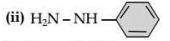 (iii)Conc. (b) Distinguish between following: (i) and (ii) Benzaldehyde andBenzoic acid OR (a) Write the final products in the following:
 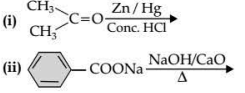 (iii) (b) Arrange the following in the increasing order of their reactivitytowards nucleophilic addition reaction:
  (c) Draw the structure of 2, 4 DNP derivative of acetaldehyde.
Solution:
(a) 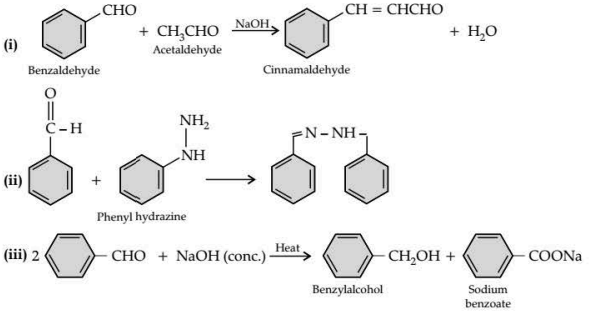 (b) (i) gives iodoform test while does not give. (ii) ● Benzaldehyde reacts with tollen's reagent to form silver mirror. Benzoic acid does not give this reaction. ● With benzaldehyde does not react while benzoic acid produces brisk effervescences. OR (a)
 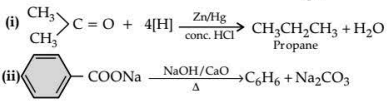 (iii)
(iii) 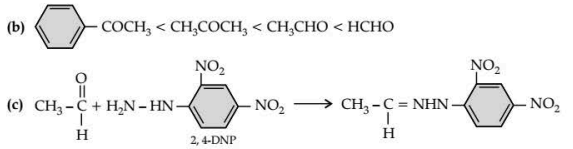
© examsnet.com
Go to Question: