(a) Given : A=0.625 cm2,l=50 cm R=5×10³ ohm,ρ=? m=0.05 m,K=? Λm=? Cell constant =Aℓ=0.625 cm250 cm=80 cm−1 Resistivity = cell constant R or lR×A ⇒505×103×0.625 ⇒80 cm−15×103 ohm ⇒62.5 ohm cm ⇒62.5 ohm cm. Conductivity = Resistivity 1×Al 5×1031×0.62550 =5×103×625×10−350=62510=0.016 Scm−1 Molar conductivity
(Λm)=M103K Λm=MK×1000=625×0.0510×1000=320 Sm2mol (b) Given:
ECu2+/Cu∘+0.34 V E(21Cl2/Cl−)∘=+1.36 V EH+/H2(g)′∘Pt=0.00 V, E(21O2/H2O)∘=+1.23 V At cathode:
Cu(aq)2++2e−→Cu(s); E∘=0.34 H(aq)++e−→21H2(g); E∘=0.000 V The reaction with a higher value of
E∘ takes place at the cathode, so deposition of copper will take place at the cathode.
At anode: The oxidation reactions are possible at the anode.
Cl(aq)−→21Cl2(g)+e−; E∘=1.36 V 2H2O(l)→O2(g)+4H+(aq)+4e−; E∘=+1.23 V At the anode the reaction with a lower value of
E∘ is preferred. But due to the over potential of oxygen,
Cl−gets oxidised at anode to produce
Cl2 gas.
OR (a)
Zn(s)/Zn2+(0.1 M)∥ (0.01 M) Ag+/Ag(s)EZn2+/Zn∘=−0.76 VEAg+/Ag∘=+0.80 Vemf=?Ecell =Ecell ∘−n0.0591log[ Cathode ] [Anode ]Ecell ∘=Ecathode ∘−Eanode ∘=EAg/Ag∘−EZn/Zn∘=0.80−(−0.76)=1.56 VEcell =1.56−20.0591log[Ag+]2[Zn2+] =1.56−20.0591log[0.01]2[0.1]=1.56−0.0295log1000=1.56−3(0.0295)=1.56−0.09=1.4715 (b)
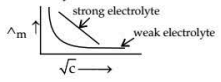
Υ is a weak electrolyte as
n dilution complete dissociation of weak electrolyte takes place and thus a sharp increase in molar conductivity while in strong electrolyte it has already dissociated completely. So on dilution molar conductivity does not rises much.