Test Index
CBSE Class 12 Physics 2013 Paper
© examsnet.com
Question : 29 of 29
Marks:
+1,
-0
State Biot-Savart law, expressing it in the vector form. Use it to obtain the expression for the magnetic field at an axial point, distance ' ' from the centre of a circular coil of radius 'a' carrying current 'T. Also find the ratio of the magnitudes of the magnetic field of this coil at the centre and at an axial point for which . OR (a) Draw the magnetic field lines due to a current carrying loop. (b) State using a suitable diagram, the working principle of a moving coil galvanometer. What is the function of a radial magnetic field and the soft iron core used in it? (c) For converting a galvanometer into an ammeter, a shunt resistance of small value is used in parallel, whereas in the case of a voltmeter a resistance of large value is used in series. Explain why.
Solution:
Biot-Savart law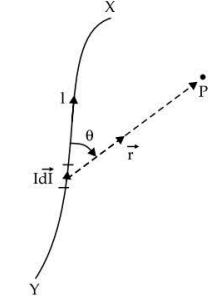 is a current carrying wire. is a small element on it.At point , whose position vector is , the magnetic field is to be determined.According to Biot Savart law, the magnitude of magnetic field at is(i) Proportional to current I(ii) Proportional to length dl(iii) Inversely proportional to the square of the distance of the pointThe direction of magnetic field is perpendicular to the plane containing and .In vector form, Or, Magnetic field due to a current carrying circular coil: A single turn circular coil of radius a carrying current is considered. is a point on the axis at a distance where the magnetic field is to be determined. Two small lengths are considered at two diametrical opposite ends on the coil. Distance of point from is . If is the magnetic field, then The 2 components of are and . The two components corresponding to two dl elements (at the upper and the lower end) cancel each other. The two components are in same direction and hence resultant magnetic field at becomes . So, the resultant magnetic field at point due to the entire coil is Or, Or, [since at a time two dl portions have been considered at two diametrical opposite ends.]
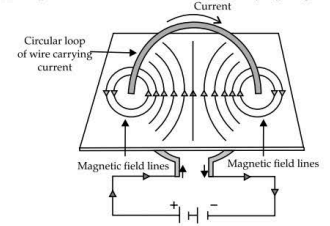
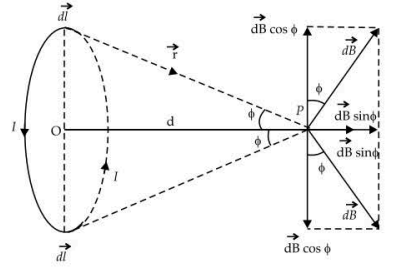 Or, [ Or, Or, Ratio of magnetic fields: When At centre So, the ratio OR (a) Magnetic field; lines due to current carrying loop:
 (b) Working principle of Moving coil galvanometer:
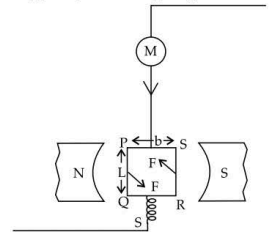 PQRS is a rectangular coil, of copper wire of length and breadth , having number of turns, current flowing through it, is hung in a permanent magnetic field B with the help of a phosphor bronze strip. Force acting on PQ and SR is . These two forces are oppositely directed. So, the moment of deflecting couple is As the coil rotates, a restoring torque is produced in the phosphor bronze strip, where c is the torsional constant and is the angle of twist. At equilibrium, Function of radial magnetic field: Due to radial magnetic field, magnetic field lines become perpendicular to magnetic moment and hence the torque becomes maximum. Function of soft iron core: Using soft iron core sensitivity increases since the magnetic field lines prefer to pass through soft iron. (c) A shunt resistance of small value is connected in parallel with a galvanometer to convert it to an ammeter. Ammeter is used in series in a circuit. Its resistance should be as low as possible so that it does not make any change in the circuit current. So, a low resistance is connected in parallel with the galvanometer to achieve this. A high value resistance is connected in series with a galvanometer to convert it to an voltmeter. Voltmeter is used in parallel to a component in a circuit. Its resistance should be as high as possible so that it does not make any change in the circuit current. So, a high value resistance is connected in series with the galvanometer to achieve this.
© examsnet.com
Go to Question: