Test Index
CBSE Class 12 Physics 2014 Delhi Set 1 Paper
© examsnet.com
Question : 25 of 30
Marks:
+1,
-0
(a) State Ampere's circuital law, expressing it in the integral form. (b) Two long coaxial insulated solenoids, and of equal lengths are wound one over the other as shown in the figure. A steady current "I" flow through the inner solenoid to the other end , which is connected to the outer solenoid through which the same current " " flows in the opposite direction so as to come out at end A. If and are the number of turns per unit length,s find the magnitude and direction of the net magnetic field at a point (i) inside on the axis and (ii) outside the combined system. 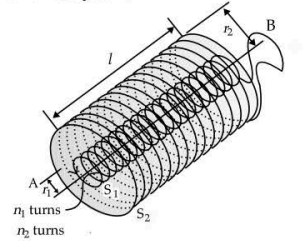
Solution:
(a) Ampere's circuital law states that the circulation of the resultant magnetic field along a closed, plane curve is equal to times the total current crossing the area bounded by the closed curve, provided the electric field inside the loop remains constant.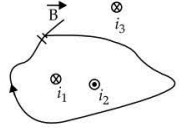 In the above illustration, the Ampere's circuital law can be written as follows: (b) (i) The magnetic field due to a current carrying solenoid: where, number of turns per unit length, current through the solenoid. Now, the magnetic field due to solenoid will be in the upward direction and the magnetic field due to will be in the downward direction (by righthand screw rule).(ii) The magnetic field is zero outside a solenoid.
© examsnet.com
Go to Question: