Test Index
CBSE Class 12 Physics 2014 Delhi Set 1 Paper
© examsnet.com
Question : 28 of 30
Marks:
+1,
-0
(a) (i) 'Two independent mono-chromatic sources of light cannot produce a sustained interference pattern'. Give reason(ii) Light wave each of amplitude ' ' and frequency ' ', emanating from two coherent light sources superpose at a point. If the displacements due to these wave is given by and where is the phase difference between the two, obtain the expression for the resultant intensity at the point.(b) In Young's double slit experiment, using monochromatic light of wavelength , the intensity of light at a point on the screen where path difference is , is units. Find out the intensity of light at a point where path difference is . OR (a) How does one demonstrate, using a suitable diagram, that unpolarised light when passed through a polaroid gets polarized?(b) A beam of unpolarised light is incident on a glass-air interface. Show, using a suitable ray diagram, that light reflected from the interface is totally polarised, when , where is the refractive index of glass with respect to air and is the Brewster's angle.
Solution:
(a) (i) The condition for the sustained interference is that both the sources must be coherent (i.e., they must have the same wavelength and the same frequency, and they must have the same phase or constant phase difference). Two sources are monochromatic if they have the same frequency and wavelength. Since, they are independent, i.e., they have different phases with irregular difference, they are not coherent sources.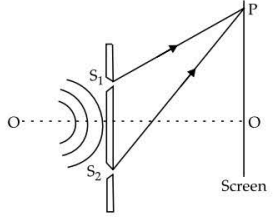 Let the displacement of the waves from the sources and at point on the screen at any time be given by: and Where, is the constant phase difference between the two waves. By the superposition principle, the resultant displacement at point is given by: .......(i) Let .......(ii) Then, equation (i) becomes Now, we have: .......(iii) Then intensity of light is directly proportional to the square of the amplitude of the wave. The intensity of light at point on the screen is given by (b) When path difference is , phase difference is (given) When path difference, , the phase difference
© examsnet.com
Go to Question: