Test Index
CBSE Class 12 Physics 2014 Outside Delhi Set 1 Paper
© examsnet.com
Question : 28 of 30
Marks:
+1,
-0
Draw a labelled diagram of Van de Graff generator. State its working principle to show how by introducing a small charged sphere into larger sphere, large amount of charge can be transferred to the outer sphere. State the use of this machine and also point out its limitations. OR (a) Deduce the expression for the torque acting on a dipole of dipole moment in the presence of a uniform electric field . (b) Consider two hollow concentric spheres, and , enclosing charges and respectively as shown in the figure.(i) Find out the ratio of the electric flux through them.(ii) how will the electric flux through the sphere change if a medium of dielectric constant ' ', ' ', is introduced in the space inside in place of air?Deduce the necessary expression. 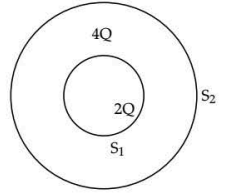
Solution:
OR (a) Consider an electric dipole consisting of charges and and of length placed in a uniform electric field making an angle with electric field. Force on charge at (opposite to ) Force on charge at along Electric dipole is under the action of two equal and unlike parallel force, which give rise to a torque on the dipole. Perpendicular distance between the two forces (b) (i) Charge enclosed by sphere By Gauss' law, electric flux through sphere is Charge enclosed by sphere is Electric flux through sphere is The ratio of the electric flux is (ii) For sphere , the electric flux is
© examsnet.com
Go to Question: