Test Index
CBSE Class 12 Physics 2014 Outside Delhi Set 3 Paper
© examsnet.com
Question : 8 of 9
Marks:
+1,
-0
(a) A rod length ' is moved horizontally with a uniform velocity ' ' in a direction perpendicular to its length through a region in which a uniform magnetic field is acting vertically downward. Derive the expression for the emf induced across the ends of the rod. (b) How does one understand this motional emf by involving the Lorentz force acting on the free charge carriers of the conductor? Explain.
Solution:
(a) Consider a rod PQ of length moving in a magnetic field with a constant velocity . The length of the rod is perpendicular to the magnetic field and also the velocity is perpendicular to both the rod and field. The free electrons of the rod also move at this velocity because of which it experiences a magnetic force. 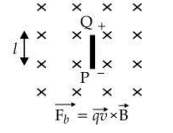 This force is towards to .Thus, the free electrons will move towards and positive charge will appears at . An electrostatic field is developed within the wire from to . This field exerts a force.on each free electron. The charge keeps on gathering untilAfter this, resultant force on the free electrons of the wire becomes zero. The potential difference between the ends and is given by, Thus, the potential difference is maintained by the magnetic force on the moving free electron and hence, produces an emf. (b) Lorentz force acting on a charge which is moving with a speed in a (normal) uniform magnetic field , is .All the charges will experience the same force. Work done to move the charge from to .
© examsnet.com
Go to Question: