Test Index
CBSE Class 12 Physics 2015 Delhi Set 1 Paper
© examsnet.com
Question : 25 of 26
Marks:
+1,
-0
(a) Using Huygens's construction of secondary wavelets explain how a diffraction pattern is obtained on a screen due to a narrow slit on which a monochromatic beam of light is incident normally. (b) Show that the angular width of the first diffraction fringe is half that of the central fringe. (c) Explain why the maxima at become weaker and weaker with increasing . OR(a) A point object ' ' is kept in a medium of refractive index in front of a convex spherical surface of radius of curvature which separates the second medium of refractive index from the first one, as shown in the figure.Draw the ray diagram showing the image formation and deduce the relationship between the object distance and the image distance in terms of and .(b) When the image formed above acts as a virtual object for a concave spherical surface separating the medium from , draw this ray diagram and write the similar (similar to (a)) relation. Hence obtain the expression for thelens maker's formula.
Solution:
(a) Explanation of diffraction pattern using Huygen's construction (b) Showing the angular width of first diffraction fringe as half of the central fringe (c) Explanation of decrease in intensity with increasing (a)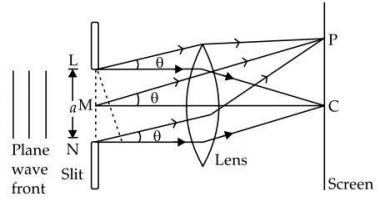 A plane wavefront from a monochromatic source is incident on the slit LN. According to Huygens' principle each point of the incident wavefront becomes the source of secondarywavelet. These wavelets emerge with the same phase. These wavelets reach point with same phase. Due to constructive interference central maximum is formed at . The wavelets which meet at point (other than point C) have different phasessince they traverse different paths to reach and accordingly they produce either maxima or minima. Thus a diffraction pattern is generated. (b)
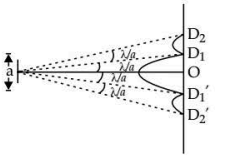 Condition for first minimum on the screen angular width of the central fringe on the screen (from figure) Angular width of first diffraction fringe (From fig) Hence angular width of central fringe is twice the angular width of first fringe. (c) Maxima become weaker and weaker with increasing . This is because the effective part of the wavefront, contributing to the maxima, becomes smaller and smaller, with increasing . OR (a)
 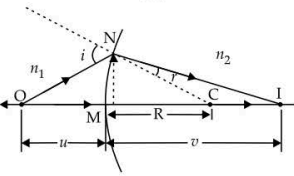 For small angles In , .....(i) Similarly, ......(ii) Using Snell's Law For small angles Substituting for and , we get Here, Substituting these, we get
 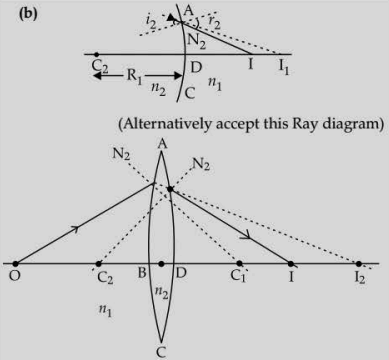 Similarly relation for the surface ADC. ......(i) Refraction at the first surface of the lens. .....(ii) Adding (i) and (ii) and taking , we get Here,
© examsnet.com
Go to Question: