Test Index
CBSE Class 12 Physics 2017 Delhi Set 3 Paper
© examsnet.com
Question : 6 of 8
Marks:
+1,
-0
Explain briefly with the help of necessary diagrams, the forward and the reverse biasing of a - junction diode. Also draw their characteristic curves in the two cases.
Solution:
Circuit diagrams of junction under forward bias and reverse bias Explanation of junction working for forward and reverse bias Characteristic curves for the two cases 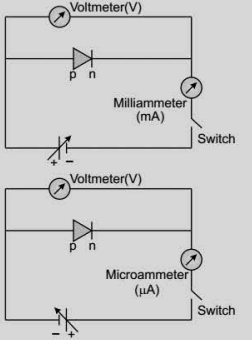 In forward bias, applied voltage does not support potential barrier. As a result, the depletion layer width decreases and barrier height is reduced. Due to the applied voltage, electrons from side cross the depletion region and reach side. Similarly holes from side cross the junction and reach the side. The motion of charged carriers, on either side, give rise to current. In reverse bias, applied voltage support potential barrier. As a result, barrier height is increased, depletion layer widens. This suppresses the flow of electrons from and holes from . Diffusion current decreases. The electric field direction of the junction is such that if electrons on side or holes on side in their random motion comes close to the junction, they will be swept to its majority zone. This drift of carriers give rise to the current called reverse current.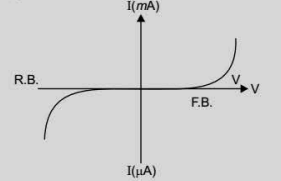
© examsnet.com
Go to Question: