Test Index
CBSE Class 12 Physics 2018 Delhi Set 1 Paper
© examsnet.com
Question : 15 of 26
Marks:
+1,
-0
(a) Show using a proper diagram how unpolarised light can be linearly polarised by reflection from a transparent glass surface. (b) The figure shows a ray of light falling normally on the face of an equilateral glass prism having refractive index , placed in water of refractive index . Will this ray suffer total internal reflection on striking the face ? Justify your answer.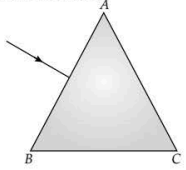
Solution:
(a) Diagram Polarisation by reflection (b) Justification Writing yes/no (a) The diagram, showing polarisation by reflection is as shown. [Here the reflected and refracted rays are at right angle to each other.] 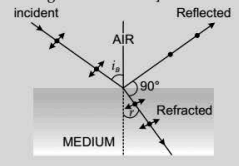 Thus light gets totally polarised by reflection when it is incident at an angle (Brewster's angle), where (b) The angle of incidence, of the ray, on striking the face is (as from figure) Also, relative refractive index of glass, with respect to the surrounding water, is Also
 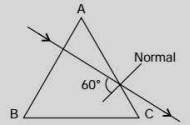 For total internal reflection, the required critical angle, in this case, is given by Hence the ray would not suffer total internal reflection on striking the face
© examsnet.com
Go to Question: