Test Index
CBSE Class 12 Physics 2018 Delhi Set 1 Paper
© examsnet.com
Question : 24 of 26
Marks:
+1,
-0
SECTION - E
(a) Define electric flux. Is it a scalar or a vector quantity?A point charge is at a distance of directly above the centre of a square of side , as shown in the figure. Use Gauss' law to obtain the expression for the electric flux through the square.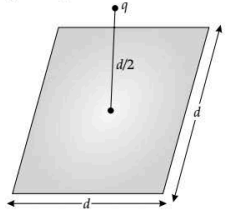
Solution:
(a) Definition of electric flux Stating scalar\/ vector Gauss's Theorem Derivation of the expression for electric flux (b) Explanation of change in electric flux (a) Electric flux through a given surface is defined as the dot product of electric field and area vector over that surface. Alternatively Also accept Electric flux, through a surface equals the surface integral of the electric field over that surface. It is a scalar quantity 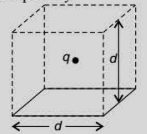 Constructing a cube of side ' ' so that charge ' ' gets placed within of this cube (Gaussian surface) According to Gauss's law the Electric flux This is the total flux through all the six faces of the cube. Hence electric flux through the square (b) If the charge is moved to a distance and the side of the square is doubled the cube will be constructed to have a side but the total charge enclosed in it will remain the same. Hence the total flux through the cube and therefore theflux through the square will remain the same as before. OR (a) Derivation of the expression for electric field (b) Graph to show the required variation of the electric field (c) Calculation of work done (a)
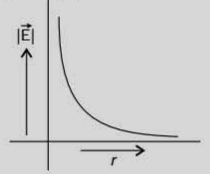
 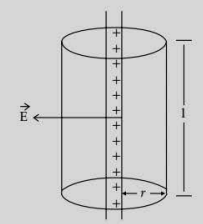 To calculate the electric field, imagine a cylindrical Gaussian surface, since the field is everywhere radial, flux through two ends of the cylindrical Gaussian surface is zero. At cylindrical part of the surface electric field is normal to the surface at every point and its magnitude is constant. Therefore flux through the Gaussian surface. Flux through the curved cylindrical part of the surface. .......(i) Applying Gauss's Law Total charge enclosed Linear charge density .......(ii) Using Equations (i) & (ii) In vector notation (where is a unit vector normal to the line charge)(b) The required graph is as shown:
  (c) Work done in moving the charge ' ' through a small displacement '' Work done in moving the given charge from to
© examsnet.com
Go to Question: