Test Index
CBSE Class 12 Physics 2023 Delhi Set 1 Paper
© examsnet.com
Question : 31 of 35
Marks:
+1,
-0
SECTION - D
(a) (i) Explain how free electrons in a metal at constant temperature attain an average velocity under the action of an electric field. Hence obtain an expression for it. (ii) Consider two conducting wires and of the same diameter but made of different materials joined in series across a battery. The number density of electrons in A is times that in B. Find the ratio of drift velocity of electrons in wire to that in wire. . OR (b) (i) A cell emf of (E) and internal resistance ( ) is connected across a variable load resistance (R). Draw plots showing the variation of terminal voltage with (i) and (ii) the current (I) in the load. (ii) Three cells, each of emf but internal resistances and are connected in parallel across a resistor . Obtain expressions for (i) current flowing in the circuit, and (ii) the terminal potential difference across the equivalent cell.
Solution: 👈: Video Solution
(a) (i) In absence of any electric field, the free electrons in metals move haphazardly in all possible directions and hence, develop no net flow of current. When an electric field is applied, a force acts on the electrons and the electrons now tend to move in the direction of the force. When electron collides with lattice, its velocity becomes instantaneously zero and then again it starts moving in a specific direction due to the applied electric field. If the average time between two collisions (relaxation time) is , then Where average drift distance , a constant, which depends on the nature of the material and the temperature. Thus, free electrons in a metal at constant temperature under the action of an electric field attain a constant average velocity. (b) Since, the wires are joined in series current flowing through then will be same. Let the current in both and be I. Diameter being same, there areas of cross section are also same. Let it be . So, in wire In wire , Taking the ratio, OR (b) (i) Terminal voltage vs. load resistance graph: And ∴ Or, ∴ 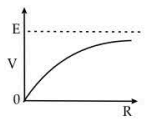 Terminal voltage vs. current graph:
 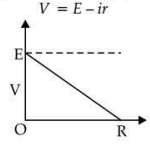 (ii) Three cells combination diagram is given below,
 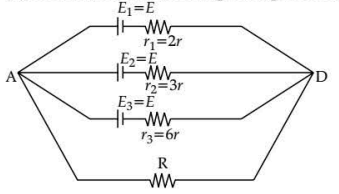 Current through cells .....(i) And Or, Equivalent resistance of internal resistance Putting in equation (i), So, the equivalent circuit is,
 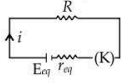 (i) Current flowing through the circuit (ii) Terminal potential difference,
© examsnet.com
Go to Question: