Test Index
NCERT Class XI Chemistry Hydrocarbons Solutions
© examsnet.com
Question : 16 of 25
Marks:
+1,
-0
Addition of HBr to propene yields 2-bromopropane, while in the presence of benzoyl peroxide, the same reaction yields 1- bromopropane. Explain and give mechanism.
Solution:
Addition of HBr to propene takes place as per the Markownikoff’s rule via the formation of most stable carbocation as follows : Step 1 : 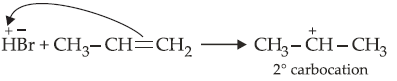 Step 2 :
 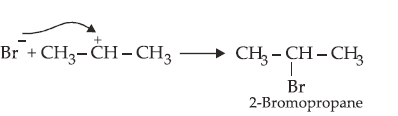 Thus, it is an example of electrophilic addition reaction. But, when the same reaction is carried out in the presence of peroxide, which is a free-radical generator, the mechanism follows free radical mechanism where the intermediate is a carbon free radical. Step 1 : → Step 2 : Generation of → Step 3 : → Here, the free radical is the 2° free radical and therefore it is the one which finally forms 1-bromopropane. Step 4 : + → Step 5 : → This explains why different products are formed under different reaction conditions.
© examsnet.com
Go to Question: