Test Index
NCERT Class XI Chemistry Organic Chemistry Some basic principles and Techniques Solutions
© examsnet.com
Question : 11 of 40
Marks:
+1,
-0
Draw the resonance structures for the following compounds. Show the electron shift using curved-arrow notation. (a) (b) (c) (d) (e) (f)
Solution:
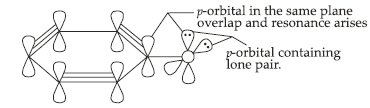
(a) Resonance structures of phenol are 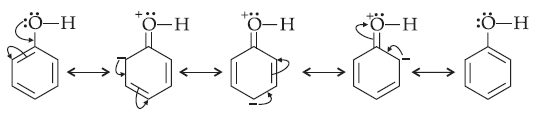 Phenol is a planar molecule. The p-orbitals on each carbon atom lie perpendicular to the plane of the molecule, the oxygen atom lying in its p-orbital is also perpendicular to the molecule. Consequently the p-orbital overlap, between O and C takes place and the resonance structures arise.
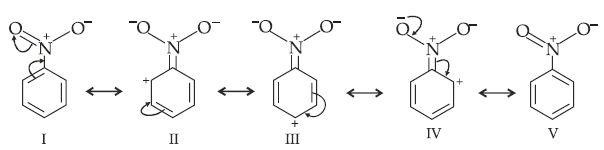
  (b) is an electron withdrawing group. As a result, it polarises the benzene molecule and resonance occurs as shown :
  (c) is an α,β-unsaturated aldehyde where the C = C gets polarised due to the neighbouring electron withdrawing – CHO group.
  (d) Oxygen being highly electronegative pulls the π-electron cloud of the C=O towards itself thereby leaving the carbonyl carbon with a positive charge. In order to compensate this electron deficiency, the electron cloud from the ring moves towards it and the resonance structures arise.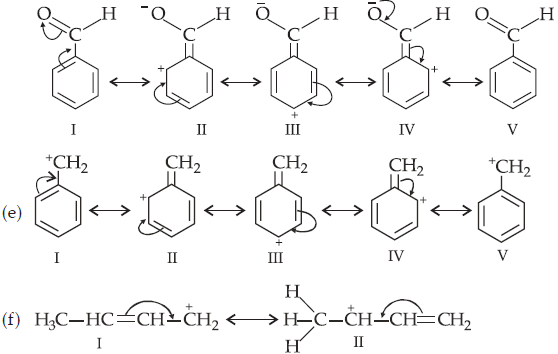
© examsnet.com
Go to Question: