Test Index

NCERT Class XI Chemistry Organic Chemistry Some basic principles and Techniques Solutions

© examsnet.com
Question : 13 of 40
Marks: +1, -0
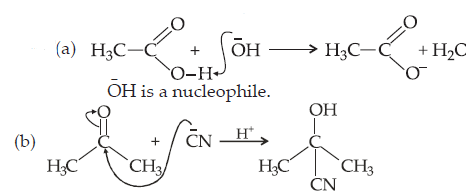
Identify the reagents shown in brackets in the following equations as nucleophiles or electrophiles :
(a) CH3COOH+(HO−)\mathrm{CH}_3\mathrm{COOH} + (\mathrm{HO}^-) → CH3COO−+H2O\mathrm{CH}_3\mathrm{COO}^- + \mathrm{H}_2\mathrm{O}
(b) CH3COCH3+(CN−)\mathrm{CH}_3\mathrm{COCH}_3 + (\mathrm{CN}^-) → (CH3)2C(CN)(OH)\mathrm{(CH_3)_2C(CN)(OH)}
(c) C6H6+(CH3C+O)\mathrm{C_6H_6} + (\mathrm{CH}_3\mathrm{C}^+\mathrm{O}) → C6H5COCH3\mathrm{C_6H_5COCH_3}
Solution:  
−CN\mathrm{^{-}CN} is a nucleophile.
The carbonyl carbon is a positive centre, since the oxygen withdraws the carbonyl electron and leaves the carbon atom electron deficient.
CH3CO+\mathrm{CH}_3\mathrm{CO}^+ is an electrophile. Benzene being an electron rich molecule, is most suitable for an electrophilic attack.
© examsnet.com
Go to Question: