Test Index
NCERT Class XI Mathematics - Linear Inequalities - Solutions
© examsnet.com
Question : 47 of 65
Marks:
+1,
-0
2x + y ≥ 4, x + y ≤ 3, 2x – 3y ≤ 6
Solution:
We have the inequalities : 2x + y ≥ 4 ... (1) x + y ≤ 3 ... (2) 2x – 3y ≤ 6 ... (3) 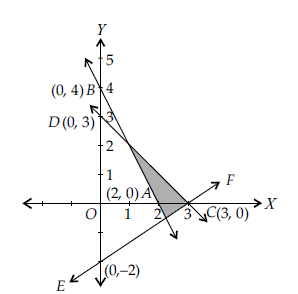 We first draw the graph of lines : 2x + y = 4, : x + y = 3 and : 2x – 3y = 6 (i) 2x + y = 4, passes through (2, 0) and (0, 4) which is represented by AB. Consider the inequality 2x + y ≥ 4 Putting x = 0, y = 0 in 2x + y ≥ 4, we get 0 ≥ 4 is false. ∴ Origin does not lie in the region of 2x + y ≥ 4 This inequality represents the region above the line AB and all the points on the line AB. (ii) Again, x + y = 3 is represented by the line CD, passes through (3, 0) and (0, 3). Consider the inequality x + y ≤ 3 , putting x = 0, y = 0 in x + y ≤ 3, we get 0 ≤ 3 is true. ∴ Origin lies in the region of x + y ≤ 3 ∴ x + y ≤ 3 represents the region below the line CD and all the points on the line CD. (iii) Further, 2x – 3y = 6 is represented by EF passes through (0, –2) and (3, 0). Consider the inequality 2x – 3y ≤ 6, putting x = 0, y = 0 in 2x – 3y ≤ 6, we get 0 < 6, which is true. ∴ Origin lies in it. ∴ 2x – 3y ≤ 6 represents the region above the line EF and all the points on the line EF. ∴ Shaded triangular area in the figure is the solution of given inequalities.
© examsnet.com
Go to Question: