Test Index
Laws of Motion
© examsnet.com
Question : 24 of 40
Marks:
+1,
-0
Figure shows the position-time graph of a body of mass 0.04 kg. Suggest a suitable physical context for this motion. What is the time between two consecutive impulses received by the body? What is the magnitude of each impulse? 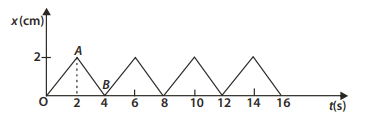
Solution:
Here, . Position time graph shows that the particle movesfrom at O to cm at A in 2 s. As x-t graph is a straight line, the motion is with a constant velocity From cm at A, particle goes to at B in 2 s. As AB is a straight line, motion is with constant velocity Negative sign indicates the reversal of direction of motion. This is being repeated. We can visualise a ball moving between two walls located at x = 0 and x = 2 cm, getting rebounded repeatedly on striking against each wall. On every collision with a wall, linear momentum of the ball changes. Therefore, the ball receives impulse after every two seconds.Magnitude of impulse = total change in linear momentum
© examsnet.com
Go to Question: