Test Index

Systems of Particles and Rotational Motion

© examsnet.com
Question : 16 of 33
Marks: +1, -0
From a uniform disk of radius R, a circular hole of radius R/2 is cut out. The centre of the hole is at R/2 from the centre of the original disc. Locate the centre of gravity of the resulting flat body.
Solution:  
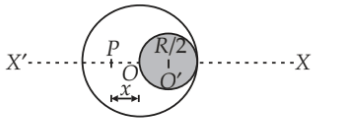
Suppose mass per unit area of the disc =m= m
∴ Mass of original disc M=πR2×mM = \pi R^2 \times m
Mass of hole removed from the disc,
M′=π(R2)2×mM' = \pi \left(\frac{R}{2}\right)^2 \times m =πR24m=M4= \frac{\pi R^2}{4} m = \frac{M}{4}
In figure, mass M is concentrated at O and mass M′M' is concentrated at O′,O', where OO′=R2OO' = \frac{R}{2}.
After the circular disc of mass M′M' is removed, the remaining portion can be considered as a system of two masses M at O and −M′- M' at O′.O'.
If xx is the distance of centre of mass (P) of the remaining part, then
x=M×0−M′×R2M−M′x = \frac{M \times 0 - M' \times \frac{R}{2}}{M - M'}
=−M4×R2M−M4= \frac{- \frac{M}{4} \times \frac{R}{2}}{M - \frac{M}{4}} =−MR8×43M=−R6= \frac{-M R}{8} \times \frac{4}{3 M} = \frac{-R}{6}
Negative sign shows that P is to the left of O.
© examsnet.com
Go to Question: