Test Index

Systems of Particles and Rotational Motion

© examsnet.com
Question : 18 of 33
Marks: +1, -0
A solid sphere rolls down two different inclined planes of the same heights but different angles of inclination. (a) Will it reach the bottom with the same speed in each case? (b) Will it take longer to roll down one plane than the other? (c) If so, which one and why?
Solution:  
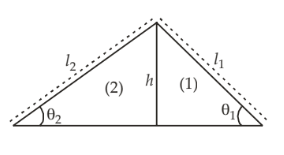
Let θ1,l1\theta_1, l_1 be the angle of inclination and distance travelled from top to bottom respectively on plane (1) and θ2,l2\theta_2, l_2 be the angle of inclination and distance travelled from top to bottom respectively on plane (2) From diagram
θ1>θ2\theta_{1}>\theta_{2} i.e. sinθ1>sinθ2\sin \theta_{1}>\sin \theta_{2} or sinθ1sinθ2>1\frac{\sin \theta_{1}}{\sin \theta_{2}}>1...(i)
h=h = height of each inclined plane =l1sinθ1=l2sinθ2= l_1\sin\theta_1 = l_2\sin\theta_2
(a) Yes. At the top of the planes, the sphere has only P.E = mgh
where m = mass of the sphere
When the sphere rolls down from the top to the bottom, converted into K.E.
∴ If v1 and v2v_1 \text{ and } v_2 be its linear speeds at the bottom of the planes, i.e. (1) and (2) respectively, then
mgh=12mv12+12Iω2=12mv22+12Iω2m g h = \frac{1}{2} m v_{1}^{2} + \frac{1}{2} I \omega^{2} = \frac{1}{2} m v_{2}^{2} + \frac{1}{2} I \omega^{2}
=(12mv12+12mk2v12R2)= \left( \frac{1}{2} m v_{1}^{2} + \frac{1}{2} m k^{2} \frac{v_{1}^{2}}{R^{2}} \right)
=12mv22+12mk2v22R2(v=Rω and I=mk2)= \frac{1}{2} m v_{2}^{2} + \frac{1}{2} m k^{2} \frac{v_{2}^{2}}{R^{2}} \left( \because v = R \omega \text{ and } I = m k^{2} \right)
or 2gh=v12(1+k2R2)2 g h = v_{1}^{2} \left(1 + \frac{k^{2}}{R^{2}}\right) and 2gh=v22(1+k2R2)2 g h = v_{2}^{2} \left(1 + \frac{k^{2}}{R^{2}}\right)
v12=2gh(1+k2R2)(ii)\therefore v_{1}^{2} = \frac{2 g h}{\left(1 + \frac{k^{2}}{R^{2}}\right)} \dots \text{(ii)}
and v22=2gh(1+k2R2)v_{2}^{2} = \frac{2 g h}{\left(1 + \frac{k^{2}}{R^{2}}\right)}...(iii)
where I = MI of the sphere, ω = its angular speed, k is the radius of gyration
From (ii) and (iii) it is clear that the sphere reaches the bottom with same speed in each case.
(b) To find the time of rolling motion : Yes, it will take longer time down one plane than the other. It will be longer for the plane having smaller angle of inclination.
(c) Explanation : Let t1 and t2t_1 \text{ and } t_2 be the time taken by the sphere in rolling on plane (1) and (2) respectively.
Acceleration of solid sphere on an inclined plane is given by,
a=gsinθ(1+k2R2)a = \frac{g \sin \theta}{\left(1 + \frac{k^{2}}{R^{2}}\right)}
Now for solid sphere 1+k2R2=1+25R2R2=751 + \frac{k^{2}}{R^{2}} = 1 + \frac{\frac{2}{5} R^{2}}{R^{2}} = \frac{7}{5}
If a1 and a2a_1 \text{ and } a_2 be the accelerations of the sphere on inclined plane (1) and (2) respectively, then
a1=gsinθ175=57gsinθ1a_{1} = \frac{g \sin \theta_{1}}{\frac{7}{5}} = \frac{5}{7} g \sin \theta_{1}
Similarly a2=57gsinθ2a_{2} = \frac{5}{7} g \sin \theta_{2}
S=ut+12at2,S = u t + \frac{1}{2} a t^{2}, we get t12=2l1a1t_{1}^{2} = \frac{2 l_{1}}{a_{1}}
=2hsinθ157gsinθ1=14h5g(sinθ1)2= \frac{ \frac{2h}{\sin\theta_{1}} }{ \frac{5}{7} g \sin\theta_{1} } = \frac{14 h}{5 g (\sin \theta_{1})^{2}}... (iv)
and t22=2l2a2t_{2}^{2} = \frac{2 l_{2}}{a_{2}}
=2hsinθ257gsinθ2= \frac{ \frac{2h}{\sin\theta_{2}} }{ \frac{5}{7} g \sin\theta_{2} }
=14h5g(sinθ2)2= \frac{14 h}{5 g (\sin \theta_{2})^{2}}...(v)
It gives t12t22=(sinθ2)2(sinθ1)2\frac{t_{1}^{2}}{t_{2}^{2}} = \frac{(\sin \theta_{2})^{2}}{(\sin \theta_{1})^{2}}
t1t2=sinθ2sinθ1\Rightarrow \frac{t_{1}}{t_{2}} = \frac{\sin \theta_{2}}{\sin \theta_{1}}...(vi)
Now from (i) sinθ1sinθ2>1\frac{\sin \theta_{1}}{\sin \theta_{2}} > 1 or sinθ2sinθ1<1\frac{\sin \theta_{2}}{\sin \theta_{1}} < 1
(sinθ2sinθ1)2<1\therefore \left( \frac{\sin \theta_{2}}{\sin \theta_{1}} \right)^{2} < 1...(vii)
∴ From (vi) and (vii), we get
t1t2<1\frac{t_{1}}{t_{2}} < 1 or t1<t2t_{1} < t_{2}
It is due to the reason that asinθa \propto \sin \theta and t is inversely proportional to ‘a’\text{`a'} or sinθ\sin\theta.
© examsnet.com
Go to Question: