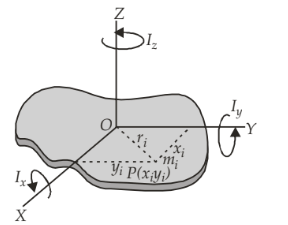
(a) Theorem of perpendicular axes : It states that the moment of inertia of a plane lamina about an axis perpendicular to its plane is equal to the sum of the moments of inertia of the lamina about any two mutually perpendicular axes in its plane and intersecting each other at the point, where the perpendicular axis passes through it.
Let OZ be the axis perpendicular to the plane lamina and passing through the point O. Let OX and OY be two mutually perpendicular axes in the plane of the lamina and intersecting at the point O.
If
Ix,Iy and Iz are the moments of inertia of the plane lamina about the axes OX, OY and OZ respectively, then according to theorem of perpendicular axes,
Iz=Ix+Iy…(i)Proof : Suppose that the rigid body is made of n particles of masses
m1,m2,…,mn lying at distance
r1,r2,…,rn from the axis of rotation OZ. Further suppose that the
ith particle of mass
mi lies at point
P(xi,yi) , such that
OP=ri . Then,
ri2=xi2+yi2Now, moment of inertia of the body about the axis OZ is given by
Iz=i=1∑nmiri2=i=1∑nmi(xi2+yi2)=i=1∑nmixi2+i=1∑nmiyi2…(ii)But
i=1∑nmixi2=Iy, moment of inertia of the body about axis OY and
i=1∑nmiyi2=Ix, the moment of inertia of the body about axis OX
Therefore, the equation (ii) becomes
Iz=Ix+Iy (b) Theorem of parallel axes : It states that the moment of inertia of a rigid body about any axis is equal to its moment of inertia about a parallel axis through its centre of mass plus the product of the mass of the body and the square of the perpendicular distance between the two axes.
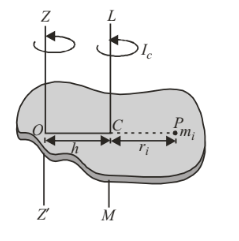
Let Ic be the moment of inertia of a body of mass M about an axis LM passing through its centre of mass C. Let I be the moment of inertia of the body about an axis ZZ′ parallel to the axis LM and at a distance h from it as shown in the figure.
Then, according to the theorem of parallel axes,
I=Ic+Mh2…(iii) Proof: Consider that
ith particle located at the point
P in the body is of mass
mi and lies at a distance
ri from the axis
LM. Then, the distance of
ith particle from axis
ZZ′ is
(ri+h). The moment of inertia of the
ith particle about the axis
LM is
miri2. Therefore, moment of inertia of the body about the axis
LM is given by
I=i=1∑nmi(ri+h)2=i=1∑nmi(ri2+h2+2hri) Now,i=1∑nmi=M, , m M ass of the body and
i=1∑nmiri=, sum of the moments of the masses of the particles constituting the body about an axis through its centre of mass. Since sum of the moments of the masses of the particles constituting the body an axis through its centre of mass must be zero,
i=1∑nmiri=0In R.H.S. of the equation (iv), substituting the values of the two factors,
we have
I=Ic+Mh2It proves the theorem of parallel axes for moment of inertia.