Test Index

Work, Power and Energy

© examsnet.com
Question : 25 of 30
Marks: +1, -0
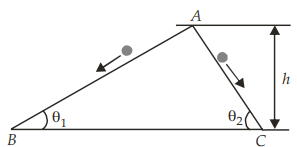
Two inclined frictionless tracks, one gradual and the other steep meet at A from where two stones are allowed to slide down from rest, one on each track as shown in figure. Will the stones reach the bottom at the same time? Will they reach there withthesame speed? Explain. Given θ1=30,θ2=60\theta_1 = 30^{\circ}, \theta_2 = 60^{\circ}, and h = 10 m, what are the speeds and times taken by the two stones?
Solution:  
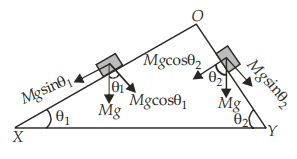
Figure shows the two inclined tracks of different lengths but of same heights, such that the angle of inclination θ2\theta_2 is greater than θ1\theta_1 . The stones along OX and OY will slide down with accelerations a1=gsinθ1a_1 = g\sin\theta_1 and a2=gsinθ2a_2 = g\sin\theta_2 respectively.
As θ2>θ1\theta_2 > \theta_1 therefore, a2>a1a_2 > a_1.
Now, for motion of the two objects :
K.E. at the bottom = P.E. at the top or Mgh=12Mv2Mgh = \frac{1}{2} M v^{2} or v=2ghv=\sqrt{2 g h}
As heights of two tracks is same, both the objects will reach the bottom withthe same speed.
Now ,v=u+at=0+at, v=u+a t=0+a t or t=vat= \frac{v}{a}
As vv is same for two objects, t1at \propto \frac{1}{a}. Since a2>a1a_2 > a_1, the object sliding on the inclined track OY will reach the bottom earlier. In other words, the two objects will reach the bottom at different times.
© examsnet.com
Go to Question: