Test Index
Work, Power and Energy
© examsnet.com
Question : 30 of 30
Marks:
+1,
-0
Consider the decay of a free neutron at rest : Show that the two-body decay of this type must necessarily give an electron of fixed energy and, therefore, cannot account for the observed continuous energy distribution to the β-decay of a neutron of a nucleus as shown in the figure.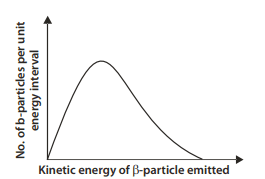
Solution:
In the decay process, energy of electron is equal to where Δm = mass defect = mass of neutron – mass of proton and electron; which is fixed. Therefore, two body decay of this type cannot explain the observed continuousenergy distribution in the b-decay of a neutron or a nucleus. Note : The simple result of this exercise was one among the several arguments advanced by W. Pauli to predict the existence of a third particle in the decay products of β-decay. The particle is known as neutrino. We now know that it is a particle of intrinsic spin (like or ), but is neutral, and either massless or having an extremely small mass (compared to electron’s mass) and which interacts very weakly with matter.The correct decay process of neutron is ].
© examsnet.com
Go to Question: