Test Index
Work, Power and Energy
© examsnet.com
Question : 4 of 30
Marks:
+1,
-0
The potential energy function for a particle executing linear simple harmonic motion is given by , where is the force constant of the oscillator. For , the graph of versus is shown in figure. Show thata particle of total energy 1 J moving under this potential must ‘turn back’ when it reaches m.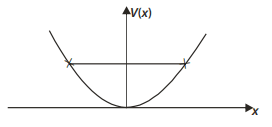
Solution:
The total energy of an oscillator is the sum of kinetic energy and potential energy at any instant.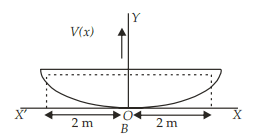 Total energy = Kinetic energy + Potential energyThe particle turn back at the instant, when its velocity becomes zero, ,Therefore ∴ Thus, the particle of total energy 1 J moving under this potential, must turn back at m.
© examsnet.com
Go to Question: