Test Index

NCERT Class XII Chapter
Alternating Current
Questions With Solutions

© examsnet.com
Question : 26 of 26
Marks: +1, -0
Repeat the same exercise as in the previous question with the replacement of the earlier transformer by a 40,000-220 V step down transformer. (Neglect, as before, leakage losses through this may not be a good assumption any longer because of the very high voltage transmission involved). Hence, explain why high voltage transmission is preferred?
Solution:  
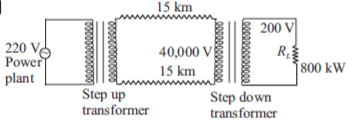
Virtual a.c in the time
IpI_p = PoutputEp\frac{P_{\text{output}}}{E_p} = 800×10340000\frac{800 \times 10^{3}}{40000} = 20 A
(a) Line power loss, PlossP_{\text{loss}} = lv2Rl_{v}^{2}R = (20)2 × 15 = 6 kW
(b) Power supplied by the plant
PTotalP_{\text{Total}} = PLoss+PoutputP_{\text{Loss}} + P_{\text{output}} = 6 kW + 800 kW = 806 kW
(c) Voltage drop in the line, V = IvRI_{v}R = 20 × 15 = 300 V.
Voltage output of step-up transformer at power station = 40,000 + 300 = 40,300 V
So, the step up transformer at the power plant is 220 V-40,300 V.
Power loss in earlier arrangement, P1P_{1} = 600×1031400×103\frac{600 \times 10^{3}}{1400 \times 10^{3}} × 100 = 43 %
Power loss in this arrangement, P2P_{2} = 6×103806×103\frac{6 \times 10^{3}}{806 \times 10^{3}} × 100 = 0.74 %
So, by supply of electricity at higher voltage, 40,000 V instead by 4000 V the power loss is reduced greatly that is why the electric power is always transmitted at very high voltage.
© examsnet.com
Go to Question: