Test Index
NCERT Class XII Chemistry
NCERT Class XII Chemistry
Chapter - Aldehydes, Ketones and Carboxylic Acids
Questions with Solutions
© examsnet.com
Question : 11 of 28
Marks:
+1,
-0
An organic compound (A) (molecular formula ) was hydrolysed with dilute sulphuric acid to give a carboxylic acid (B) and an alcohol (C). Oxidation of (C) with chromic acid produced (B). (C) on dehydration gives but-1-ene. Write equations for the reactions involved.
Solution:
Given :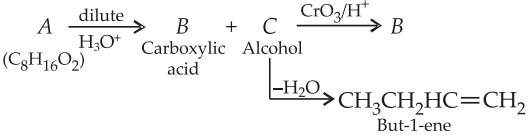 (i) Compound (A) upon hydrolysis produces one molecule each of a carboxylic acid and alcohol. This indicates that (A) is an ester. (ii) (C) upon oxidation produces (B) proving that (C) and (B) have same no. of carbon atoms. (iii) (C) on dehydration produces but-1-ene. This, coupled with the fact that it gives a carboxylic acid (B) on oxidation shows that (C) is a primary alcohol.∴ (C) is (B) is and hence, (A) is The reactions involved may be summarized as :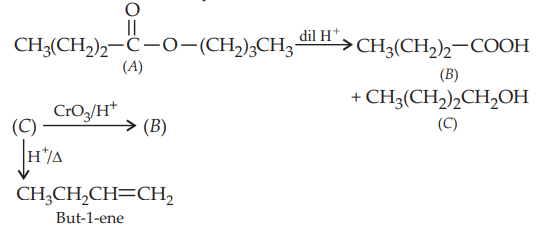
© examsnet.com
Go to Question: