Test Index
NCERT Class XII Chemistry
NCERT Class XII Chemistry
Chapter - General Principle of Process of Isolation of Elements
Questions with Solutions
© examsnet.com
Question : 7 of 31
Marks:
+1,
-0
Write down the reactions taking place in different zones in the blast furnace during the extraction of iron.
Solution:
Near the bottom of the furnace (zone of combustion, 2170 K), coke first combines with air to form which then combines with more coke (zone of heat absorption, 1423 K) to form CO. The CO thus produced acts as the reducing agent and reduces ironoxide to spongy iron near the top of the furnace (zone of reduction, 823 K).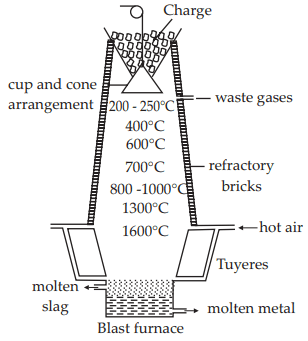 (Exothermic) (Endothermic) But the further reduction of FeO to Fe by CO occurs around 1123 K. However, direct reduction of iron ores (haematite, magnetite, etc.) leftunreduced (around 823 K) get converted completely to iron by carbon(above 1123 K). Limestone which acts as flux, decomposes at 1123 K (zone of slagformation) to form CaO which then combines with silica to form slag. Silicates, phosphates and manganates present as impurities in ore, arereduced to Si, P and Mn, respectively. At the lower part of the furnace (zone of fusion, 1423-1673 K) the spongyiron melts and dissolves some carbon, S, P, , Mn, etc.The molten slag being less dense floats over the surface of the molten iron.The molten iron is then tapped off from the furnace and is then solidifiedto give blocks of iron called cast iron or pig iron.
© examsnet.com
Go to Question: