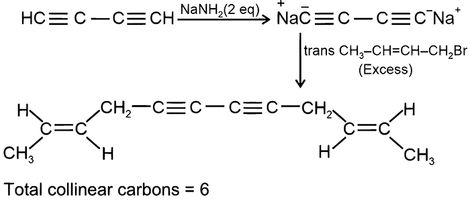
Concept:Buta-1,3-diyne with 2 equivalents of
NaNH2 forms a dianion that undergoes
SN2 substitution with excess trans-
CH3−CH=CH−CH2−Br to give product
X.
Explanation:Buta-1,3-diyne (
HC≡C−C≡CH) reacts with
NaNH2 to remove both terminal hydrogens, yielding the dianion
−C≡C−C≡C−.
This dianion reacts with two molecules of trans-
CH3−CH=CH−CH2−Br via
SN2 at the allylic carbon.
The product
X is:
CH3−CH=CH−CH2−C≡C−C≡C−CH2−CH=CH−CH3.
In
X, the central diyne chain (
−C≡C−C≡C−) is linear due to
sp hybridization of the triple-bonded carbons.
Each terminal
sp carbon of the diyne also bonds linearly to the adjacent
CH2 carbon of the allyl group, placing those two
CH2 carbons exactly on the same straight line.
Thus the carbons of the
CH2−C≡C−C≡C−CH2 fragment are all collinear.
That gives a total of 6 carbon atoms in a straight line.
The alkene carbons (
CH=CH) are not collinear with this line because the
CH2 carbon is
sp3 hybridized and the bond to the alkene is at an angle.
Hence the maximum number of collinear carbons in
X is 6.
Answer:6