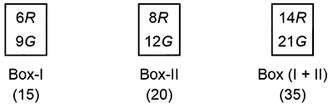
Concept:Independence of events and conditional probability are used to evaluate the given statements.Explanation:Total balls: Box I has 15, Box II has 20. Combined total is 35.Probabilities are computed as fractions of 35.
P(E1)=3515
P(E2)=3520
P(F1)=3514
P(F2)=3521
P(E1∩F1)=356
P(E1∩F2)=359
P(E2∩F1)=358
P(E2∩F2)=3512
Check each option:Option A:P(E1)⋅P(F1)=3515×3514=356=P(E1∩F1). So E1 and F1 are independent. True.Option B:P(E2)⋅P(F2)=3520×3521=3512=P(E2∩F2). Hence E2 and F2 are independent, not dependent. False.Option C:P(F1∣E1)=15/356/35=156=52. P(F1∣E2)=20/358/35=208=52. They are equal. True.Option D:P(F2∣E2)=20/3512/35=2012=53. P(F1∣E1)=52. Since 52<53, the statement is false.