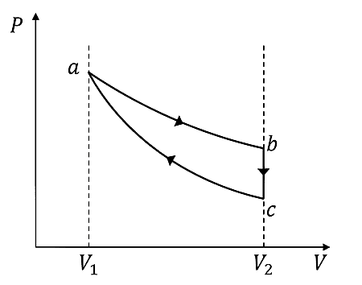
Concept:The cycle consists of isothermal, isochoric, and adiabatic processes involving a monoatomic ideal gas. Efficiency is computed from heat input and output.
Explanation:For process
a→b (isothermal expansion at temperature
Ta=Tb=T0): heat absorbed
Qab=nRT0ln(V2/V1).
For process
b→c (isochoric):
Qbc=23nR(Tc−T0).
For process
c→a (adiabatic):
Qca=0.
Using adiabatic relation
TcV2γ−1=T0V1γ−1 with
γ=5/3, so
γ−1=2/3. Thus
T0/Tc=(V2/V1)2/3.
If
V2/V1=8, then
T0/Tc=82/3=4, so
Ta=4Tc. Option C is correct.
From the ideal gas law for isothermal process:
PaV1=PbV2⇒Pa/Pb=V2/V1=8, not 4, so option D is false.
Heat released in
b→c:
∣Qbc∣=23nR(T0−Tc)=23nRT0(1−1/4)=89nRT0≈1.125nRT0.
Heat absorbed in
a→b:
Qab=nRT0ln8=3nRT0ln2≈3⋅0.7=2.1nRT0. Clearly
1.125<2.1, so option A is correct.
Efficiency
η=1−Qout/Qin. Here
Qin=Qab and
Qout=∣Qbc∣. Substituting expressions,
η depends only on
V2/V1, not on
T0. Hence option B is correct.
Answer:The correct statements are A, B, and C.