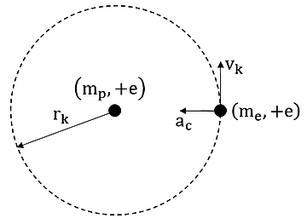
Concept:Use Bohr’s quantization and energy relations to evaluate changes in kinetic energy, de Broglie wavelength, radiation frequency, and total energy of the electron.Explanation:For the electron in a hydrogen atom, electrostatic force provides centripetal acceleration:rkmvk2=4πε0rk2e2⇒mvk2=4πε0rke2Thus kinetic energy Kk=21mvk2=8πε0rke2, total energy Ek=−Kk.Angular momentum is quantized: mvkrk=2πkh.For a transition from n to 1 (Lyman series), change in kinetic energy:∣ΔK∣=∣Kn−K1∣=4πrnnhvn−4πr1hv1=4πhrnnvn−r1v1Hence option (A) is correct.de Broglie wavelength: λk=pkh=2mKkh. Using Kk=8πε0rke2 and Bohr’s relation 2πrk=kλk, we get λk=4ε0kKke2.Change in wavelength: ∣Δλ∣=4ε0e2nKn1−1⋅K11, not as in option (B). So (B) is incorrect.Frequency of emitted radiation: hν=En−E1=−Kn−(−K1)=K1−Kn.Using Kk=8πε0rke2, we obtain hν=8πε0e2(r11−rn1), so ν=8πε0he2(r11−rn1). Option (C) is correct.Total energy change equals magnitude of kinetic energy change because ∣Ek∣=Kk. Thus ∣ΔE∣=4πhrnnvn−r1v1, not the expression in option (D). Therefore (D) is incorrect.