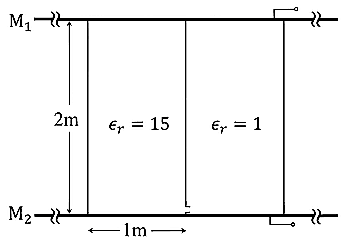
Concept:The system consists of two parallel-plate capacitors (the chambers) in parallel, each with two dielectrics in series: liquid and air. The capacitance changes as liquid flows from left to right.
Explanation:Given: Total height
H=2 m, each chamber floor area
A=1 m2 (since length = 1 m, breadth = 1 m).
For a chamber with liquid height
h and dielectric constant
εr=15, the equivalent capacitance is:
C(h)=H−h(1−εr1)ε0A=2−h(1−151)ε0.At
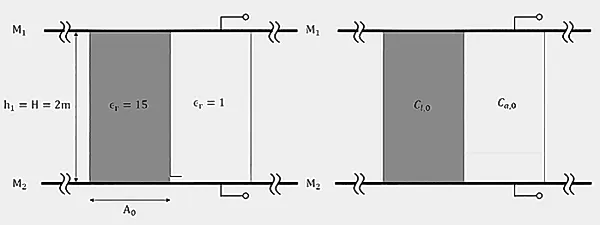
t=0: left chamber
h1=2 m, right chamber
h2=0.
Cleft,0=2−2×1514ε0=7.5ε0.
Cright,0=2−0ε0=0.5ε0.
Total
Ct=0=8ε0.
At
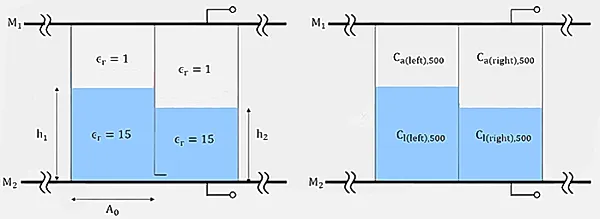
t=500 s: left chamber height
h1=1.25 m, so right chamber height
h2=2−1.25=0.75 m (by conservation of liquid volume).
Cleft,500=2−1.25×1514ε0=2−67ε0=1.2ε0=56ε0.
Cright,500=2−0.75×1514ε0=2−107ε0=1310ε0.
Total
Ct=500=56ε0+1310ε0=6578+50ε0=65128ε0.
The capacitance difference is
ΔC=Ct=0−Ct=500. Given
ΔC=(8−n)ε0, we have:
8ε0−65128ε0=(8−n)ε0⟹n=65128≈2.
Answer:n=2.