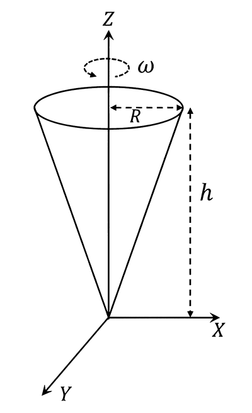
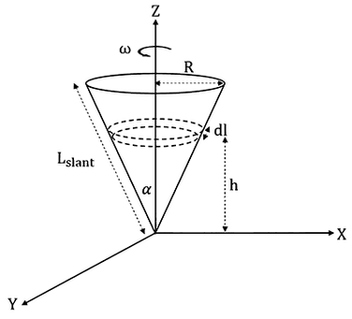
Concept:A spinning charged cone behaves like a magnetic dipole. The magnetic field far along its axis is given by B=4πμ0z32M, where M is the net magnetic dipole moment of the cone.Explanation:Let the cone have tip at origin, base radius R, height h, slant length L=R2+h2, and semi‑vertical angle α with sinα=R/L. Total charge Q is uniformly spread over the curved surface area πRL. Take a thin ring at slant distance l from tip, width dl. Its radius r=lsinα, vertical coordinate y=lcosα. Area of ring dA=2πrdl=2π(lsinα)dl. Surface charge density σ=Q/(πRL). Charge on ring: dq=σdA=πRLQ⋅2πlsinαdl=L22Qldl. When cone rotates with angular speed ω, the ring’s charge moves in a circle of radius r, giving an effective current dI=Tdq=2πωdq. Magnetic dipole moment of this ring: dM=dI⋅(πr2)=2πωdq⋅π(lsinα)2=21ωsin2αl2dq. Substitute dq: dM=21ωsin2αl2⋅L22Qldl=L2Qωsin2αl3dl. Integrate over the entire slant length: M=∫0LL2Qωsin2αl3dl=L2Qωsin2α⋅4L4=41Qωsin2αL2. Since sin2αL2=R2, we get M=41QωR2. At a far point (0,0,z) with z≫R,h, the axial magnetic field is B=4πμ0z32M=4πμ0z32(41QωR2)=214πμ0z3QR2ω. This matches the given form n4πμ0z3QR2ω with n=0.5.