Test Index
CBSE Class 12 Chemistry 2014 Outside Delhi Set 1 Solved Paper
© examsnet.com
Question : 30 of 30
Marks:
+1,
-0
(a) Write the products formed when reacts with the following reagents:(i) (ii) (iii) in the presence of dilute (b) Give simple chemical tests to distinguish between the following pairs of compounds.(i) Benzoic acid and Phenol(ii) Propanal and Propanone. OR(a) Account for the following:(i) is a stronger acid than .(ii) Carboxylic acids do not give reactions of carbonyl group.(b) Write the chemical equations to illustrate the following name reactions:(i) Rosenmund reduction(ii) Cannizzaro's reaction(c) Out of and , which gives iodoform test?
Solution:
(a) (i) Acetaldehyde reacts with hydrogen cyanide to give2-hydroxypropapanenitrile as product. (ii) Acetaldehyde reacts with Hydroxylamine to give acetaldoxime as a product. (iii) Reaction of acetaldehyde in the presence of dilute , this is the kind of Aldol reaction by which obtained 3-hydroxybutanal as product. Further proceed reaction when using heat in the reaction, its gives aldol condensation product which is But-2-enal. (b) Chemical tests to distinguish the following compounds: (i) Ferric chloride test: When phenol react with Ferric chloride, it form an Iron phenol complex which give violet colour to the solution, while Benzoic acid do not give any colour. (ii) Propanal and propanone: These two are distinguished by the iodoform when it reacts with in the presence of while propanone give iodoform test when reacts with in the presence of . OR OR(a) (i) Chloroacetic acid is stronger acid than Acetic acid because is an electron withdrawing group which increase the acidic character by dispersing electron due to presence of inductive effect. , as a result of the effect, removes electrons from the bond and reduces its electron density. Weakening the bond makes it easier for to be released. group has a positive impact. It makes the release of from acetic acid more challenging than from chloroacetic acid by increasing the electron density in the bond. Consequently, is a more potent acid than . (ii) Carboxylic acid contains carbonyl group and do not undergo nucleophilic addition reaction because oxygen atom in - contain lone pair of electrons. That's why, electrophilic character decreases because of resonance and it gives stability to the structure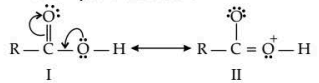 (b) (i) From acid chloride (Rosenmund's reduction): Formaldehyde cannot be prepared by this method as is highly unstable. (ii) Cannizzaro Reaction: Aldehydes undergo self -oxidation and reduction on heating with conc. alkali. The aldehydes which do not have -hydrogen undergo this reaction.
 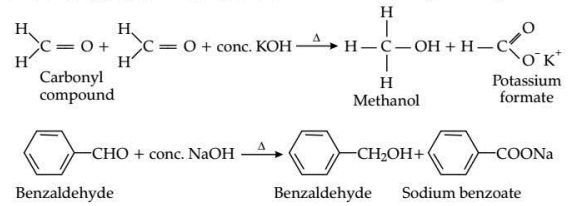 (C) Both give positive Iodoform test as they contain group in their structure.
© examsnet.com
Go to Question: