Test Index
CBSE Class 12 Chemistry 2019 Delhi Set 1 Solved Paper
© examsnet.com
Question : 24 of 27
Marks:
+1,
-0
Differentiate between the following : (i) Amylose and Amylopectin (ii) Peptide linkage and glycosidic linkage (iii) Fibrous protein and globular protein OR Write chemical reactions to show that open structure of D-glucose contains the following : (i) Straight chain (ii) Five alcohol groups (iii) Aldehyde as carbonyl group
Solution:
(i)
(ii)
(iii)
OR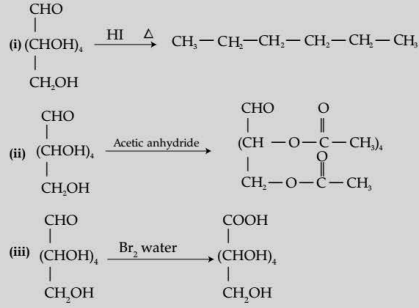
| Amylose | Amylopectin |
|---|---|
| Chemically it is straight chain polymer. | Chemically it is branched chain polymer. |
| It is soluble in water. | It is insoluble in water. |
| It constitutes ofstarch. | It constitutes ofstarch. |
| Peptide linkage | Glycosidic linkage |
|---|---|
| Peptide linkage is formed between two amino acids. | Glycosidic linkage is formed between two monosaccharides. |
| Hydrolysis of peptidelinkage forms two aminoacids. | Hydrolysis of glycosidic linkage forms two monosaccharides. |
| It links carbon and nitrogen atoms. | It links two carbon atoms through an oxygen atom. |
| It is found in polypeptides. | It is found inpolysaccharides. |
| It can be given as - - | It can be given as -C-O-C- |
| Fibrous protein | Globular protein |
|---|---|
| When the polypeptide chains run parallel and are held together by hydrogen and disulphide bonds then fibrous protein is formed. | When the chains of polypeptides coil around to get a spherical shape then globular protein is formed. |
| Generally it is insoluble in water. | Generally it is soluble in water. |
| They have comparatively stronger intermolecular forces of attraction. | They have weak intermolecular hydrogen bonding. |
© examsnet.com
Go to Question: