Test Index

CBSE Class 12 Chemistry 2019 Delhi Set 1 Solved Paper

© examsnet.com
Question : 25 of 27
Marks: +1, -0
SECTION - D
EcellE_{\text{cell}}^{\circ} for the given redox reaction is 2.71 V2.71\ \mathrm{V}.
Mg+Cu(0.01 M)2+Mg(0.001 M)2++Cu\mathrm{Mg}+\mathrm{Cu}^{2+}_{(0.01\ \mathrm{M})}\rightarrow\mathrm{Mg}^{2+}_{(0.001\ \mathrm{M})}+\mathrm{Cu}
Calculate EcellE_{\text{cell}} for the reaction. Write the direction of flow of current when an external opposite potential applied is
(i) Less than 2.71 V2.71\ \mathrm{V}
(ii) Greater than 2.71 V2.71\ \mathrm{V}
OR
(a) A steady current of 2 amperes was passed through two electrolytic cells XX and YY connected in series containing electrolytes FeSO4\mathrm{FeSO}_4 and ZnSO4\mathrm{ZnSO}_4 until 2.8 g\mathrm{g} of Fe deposited at the cathode of cell X. How long did the current flow? Calculate the mass
    (Molar mass: Fe  =56 g mol1, Zn\;\;\text{(Molar mass: Fe}\;=56\ \mathrm{g}\ \mathrm{mol}^{-1},\ \mathrm{Zn} =65.3 g mol1, 1 F=65.3\ \mathrm{g}\ \mathrm{mol}^{-1},\ 1\ \mathrm{F}
=96500 C mol1)=96500\ \mathrm{C}\ \mathrm{mol}^{-1})
(b) In the plot of molar conductivity Λm\Lambda_{\mathrm{m}} vs. square root of concentration (C1/2)(C^{1/2}), following curve obtained for two electrolytes A and B:
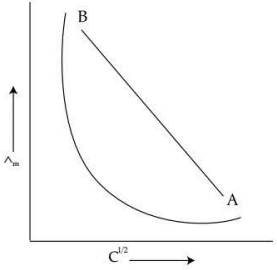
Answer the following :
(i) Predict the nature of electrolytes A and B:
(ii) What happens on extrapolation of Λm\Lambda_m to concentration approaching zero for electrolytes AA and BB ?
Solution:  
  Ecell=Ecell0.059nlog[Mg2+][Cu2+]\;E_{\text{cell}}=E_{\text{cell}}^{\circ}-\frac{0.059}{n}\log\frac{[\mathrm{Mg}^{2+}]}{[\mathrm{Cu}^{2+}]}
  Ecell=2.710.0592log[0.001][0.01]\;E_{\text{cell}}=2.71-\frac{0.059}{2}\log\frac{[0.001]}{[0.01]}
  Ecell=2.71(0.0295)=2.74 V\;E_{\text{cell}}=2.71-(-0.0295)=2.74\ \mathrm{V}
(i) When external opposite applied voltage is less than 2.71, it is less than EcellE_{\text{cell}}^{\circ}, therefore, the electrons will flow from the anode to the cathode, and current will flow from cathode (copper electrode) to anode (magnesium electrode).
(ii) When external opposite applied potential is greater than 2.71, it is greater than EcellE_{\text{cell}}^{\circ}, therefore, the reaction will be reversed, and the current will flow from anode to cathode.
OR
(a) Charge required to deposite 2.8 g Fe2.8\ \mathrm{g}\ \mathrm{Fe} :
mol Fe=massmolar mass\mathrm{mol\ Fe}=\frac{\text{mass}}{\text{molar mass}} =2.8 g56 gmol1=0.05 mol=\frac{2.8\ \mathrm{g}}{56\ \mathrm{g}\cdot\mathrm{mol}^{-1}}=0.05\ \mathrm{mol}
2 F2\ \mathrm{F} charge is required to discharge 1 mol1\ \mathrm{mol} of Fe2+\mathrm{Fe}^{2+} ions as Fe\mathrm{Fe}, therefore deposition of 0.05 mol Fe0.05\ \mathrm{mol}\ \mathrm{Fe} will need
0.05×2=0.1 F=0.1 F0.05\times2=0.1\ \mathrm{F}=0.1\ \mathrm{F} ×96500 CF=9650 C\times\frac{96500\ \mathrm{C}}{\mathrm{F}}=9650\ \mathrm{C}
The quantity of charge is related to current as
Q=ItQ=It
Therefore, the time needed to deposit 2.8 g2.8\ \mathrm{g} Fe is:
t=QI=9650 C2 A=4825 st=\frac{Q}{I}=\frac{9650\ \mathrm{C}}{2\ \mathrm{A}}=4825\ \mathrm{s}
So, the current flowed through the cells for 4825 seconds.
The amount of Zn\mathrm{Zn} deposited in cell YY can be calculated using Faraday's second law:
    mass of Znmass of Fe=Eq.wt of ZnEq wt of Fe\;\;\frac{\text{mass of}\ \mathrm{Zn}}{\text{mass of}\ \mathrm{Fe}}=\frac{\text{Eq.wt of}\ \mathrm{Zn}}{\text{Eq wt of}\ \mathrm{Fe}}
      =molar mass of Zncharge on zinc ionmolar mass of Fecharge on iron ion\;\;\;=\frac{\frac{\text{molar mass of}\ \mathrm{Zn}}{\text{charge on zinc ion}}}{\frac{\text{molar mass of}\ \mathrm{Fe}}{\text{charge on iron ion}}}
    mass of Zn=2.8 g×65.3 g/256 g/2\;\;\text{mass of}\ \mathrm{Zn}=2.8\ \mathrm{g}\times\frac{65.3\ \mathrm{g}/2}{56\ \mathrm{g}/2} =3.265 g3.3 g=3.265\ \mathrm{g}\approx3.3\ \mathrm{g}
Therefore, the mass of Zn\mathrm{Zn} deposited in cell YY in the same time is 3.3 g3.3\ \mathrm{g}.
(b) (i) Molar conductivity of strong electrolytes increases linearly as the square root of the concentration decreases; therefore, electrolyte A is a strong electrolyte. Molar conductivity of weak electrolytes increases non-linearly as square root of concentration decreases; therefore, electrolyte B is a weak electrolyte.
(ii) As concentration of strong electrolyte approaches zero, the molar conductivity of the plot intercepts the molar conductivity axis, giving the limiting value of molar conductivity Em0E_m^0. The plot of molar conductivity of weak electrolyte tends to infinity as its concentration approaches zero; it does not intersect the molar conductivity axis.
© examsnet.com
Go to Question: