Test Index
CBSE Class 12 Physics 2016 Outside Delhi Set 1 Paper
© examsnet.com
Question : 26 of 26
Marks:
+1,
-0
(i) Use Gauss's law to find the electric field due to a uniformly charged infinite plane sheet. What is the direction of field for positive and negative charge densities? (ii) Find the ratio of the potential differences that must be applied across the parallel and series combination of two capacitors and with their capacitances in the ratio so that the energy stored in the two cases becomes the same. OR (i) If two similar large plates, each of area having surface charge densities and are separated by a distance in air, find the expressions for (a) field at points between the two plates and on outer side of the plates. Specify the direction of the field in each case. (b) the potential difference between the plates. (c) the capacitance of the capacitor so formed. (ii) Two metallic spheres of radii and are charged so that both of these have same surface charge density . If they are connected to each other with a conducting wire, in which direction will the charge flow and why?
Solution:
(i) Derivation for electric field due to infinite plane Sheet of charge Directions of field (ii) Formula Calculation and result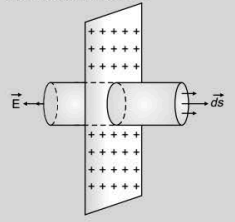 Symmetry of situation suggests that is perpendicular to the plane. A Gaussian surface is considered through like a cylinder of flat caps parallel to the plane and one cap passing through . The plane being the plane of symmetry for the Gaussian surface. for all over curved surface and hence By Gauss' law If is positive points normally outwards/ away from the sheet If is ve points normally inwards/towards the sheet OR(i) Deriving the expression for field between the plate & outside Direction of electric field inside and outside Potential difference between the plates Capacitance (ii) Direction of flow of charge
 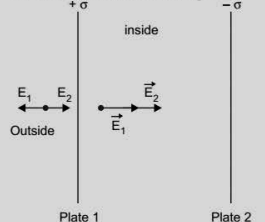 Inside Outside (b) Potential difference between plates (c) Capacitance (ii) As potential on and inside a charged sphere is given Hence, the bigger sphere will be at higher potential, so charge will flow from bigger sphere to smaller sphere.
© examsnet.com
Go to Question: