Test Index
CBSE Class 12 Physics 2016 Outside Delhi Set 1 Paper
© examsnet.com
Question : 25 of 26
Marks:
+1,
-0
(i) Derive the mathematical relation between refractive indices and of two radii and radius of curvature for refraction at a convex spherical surface. Consider the object to be a point since lying on the principle axis in rarer medium of refractive index and a real image formed in the denser medium of refractive index . Hence, derive lens maker's formula. (ii) Light from a point source in air falls on a convex spherical glass surface of refractive index 1.5 and radius of curvature . The distance of light source from the glass surface is . At what position is the image formed? OR (a) Draw a labelled ray diagram to obtain the real image formed by an astronomical telescope in normal adjustment position. Define its magnifying power. (b) You are given three lenses of power 0.5 D, 4 and to design a telescope. (i) Which lenses should be used as objective and eyepiece? Justify your answer. (ii) Why is the aperture of the objective preferred to be large? .
Solution:
(i) Derivation of 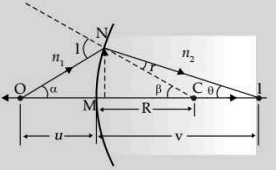 Ray diagram showing real image formation as per description For paraxial rays and are small Therefore, (Snell's law) Reduces to Applying above relations to refraction through a lens:
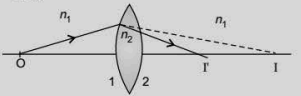 For surface 1 ......(i)For surface 2 ......(ii)Adding eqn. (i) and (ii), For (iii) a real image on the other side, away from the surface. OR (a) Labelled ray diagram of Astronomical TelescopeDefinition of magnifying power(b) (i) Identification of lenses Justification(ii) Reason
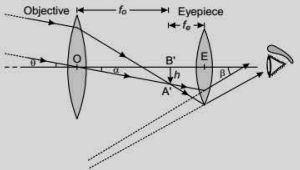 Definition-It is the ratio of the angle subtended at the eye, by the final image, to the angle which the object subtends at the lens, or the eye.(b) (i) Objective Eye lens This choice would give higher magnification as (ii) High resolving power / Brighter image / lower limit of resolution
© examsnet.com
Go to Question: