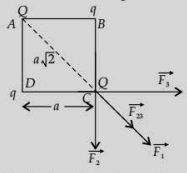
Four point charges Q,q,Q and q are placed at the corners of a square of side ' a ' as shown in the figure.
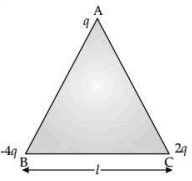
Find the (a) resultant electric force on a charge Q and (b) potential energy of this system. OR (a) Three point charges q,−4q and 2q are placed at the vertices of an equilateral triangle ABC of side ' l ' as shown in the figure. Obtain the expression for the magnitude of the resultant electric force acting on the charge q.
(b) Find out the amount of the work done to separate the charges at infinite distance.
Solution:
(a) Finding the resultant force on a charge Q (b) Potential Energy of the system (a) Let us find the force on the charge Q at the point C F1=4πϵ01(a2)2Q2=4πϵ01(2a2Q2) (along AC ) Force due to the charge q (at B ), F2=4πϵ01a2qQ along BC Force due to the charge q (at D ), F3=4πϵ01a2qQ along DC Resultant of these two equal forces
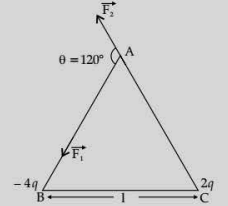
Force due to the other charge QF23=4πϵ01a2qQ(2) (along AC ) ∴ Net force on charge Q ( at point C ) F=F1+F23=4πϵ01a2Q[2Q+2q] This force is directed along AC(For the charge Q , at the point A , the force will have the same magnitude but will be directed along CA )[Note : Don't deduct marks if the student does not write the direction of the net force, F](b) Potential energy of the system =4πϵ01[4aqQ+a2q2+a2Q2]=4πϵ0a1[4qQ+2q2+2Q2]OR(a) Finding the magnitude of the resultant force on charge q(b) Finding the work done (a) Force on charge q due to the charge −4qF1=4πϵ01(l24q2), along ABForce on the charge q, due to the charge 2qF2=4πϵ01(l22q2), along CAThe forces F1 and F2 are inclined to each other at an angle of 120∘
Hence, resultant electric force on charge qF=F12+F22+2F1F2cosθ=F12+F22+2F1F2cos120∘=F12+F22−F1F2=(4πϵ01l2q2)16+4−8=4πϵ01(l223q2)(b) Net P.E. of the system=4πϵ01⋅lq2[−4+2−8]=4πϵ0−10lq2∴ Work done =4pϵ0l10q2=2πϵ0l5q2

 Force due to the other charge Net force on charge ( at point ) This force is directed along (For the charge , at the point , the force will have the same magnitude but will be directed along )[Note : Don't deduct marks if the student does not write the direction of the net force, (b) Potential energy of the system OR(a) Finding the magnitude of the resultant force on charge (b) Finding the work done (a) Force on charge due to the charge Force on the charge , due to the charge The forces and are inclined to each other at an angle of
  Hence, resultant electric force on charge (b) Net P.E. of the system