Test Index
CBSE Class 12 Physics 2019 Outside Delhi Set 1 Paper
© examsnet.com
Question : 26 of 27
Marks:
+1,
-0
Explain, with the help of a diagram, how plane polarized light can be produced by scattering of light from the Sun. Two polaroids and are placed with their pass axes perpendicular to each other. Unpolarised light of intensity is incident on . A third polaroid is kept between and such that its pass axis makes an angle of with that of . Calculate the intensity of light transmitted through and . OR (a) Why cannot the phenomenon of interference be observed by illuminating two pin holes with two sodium lamps? (b) Two monochromatic waves having displacements and from two coherent sources interfere to produce an interference pattern. Derive the expression for the resultant intensity and obtain the conditions for constructive and destructive interference. (c) Two wavelengths of sodium light of and are used in turn to study the diffraction taking place at a single slit of aperture . If the distance between the slit and the screen is . Calculate the separation between the positions of the second maxima of diffraction pattern obtained in the two cases.
Solution:
ns. Diagram production of polarized light by scattering of sun light ● Explanation ● Calculation of intensity of light transmitted through and Diagram : 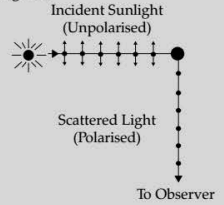 Explanation: Charges accelerating parallel to the double arrows do not radiate energy towards the observer. The radiation scattered by the molecules therefore is polarised perpendicular to the plane of the figure. Alternatively: If the student writes " scattered light when viewed in a perpendicular direction is found to be polarised (Award one mark) Intensity of light transmitted by Polaroid is, Intensity of light transmitted by Polaroid is, Intensity of light transmitted by Polaroid is, OR ● Reason ● Deriving the expression for resultant intensity and condition for constructive and destructive interference ● Calculating the separation (a) Because two independent sources cannot be coherent OR they are not coherent (b) So resultant displacement is give by The amplitude of the resultant displacement is and therefore intensity at that point will be For constructive interference: For destructive interference: (c) Position of second maxima, Separation between the positions of the second maxima with and is:
© examsnet.com
Go to Question: