Test Index
CBSE Class 12 Physics 2020 Outside Delhi Set 1 Paper
© examsnet.com
Question : 28 of 37
Marks:
+1,
-0
SECTION - C
A hollow conducting sphere of inner radius and outer radius has a charge on its surface. A point charge is also placed at the centre of the sphere. (a) What is the surface charge density on the (i) inner and (ii) outer surface of the sphere ? (b) Use Gauss' law of electrostatics to obtain the expression for the electric field at a point lying outside the sphere. OR (a) An infinitely long thin straight wire has a uniform linear charge density . Obtain the expression for the electric field (E) at a point lying at a distance from the wire, using Gauss' law. (b) Show graphically the variation of this electric field E as a function of distance from the wire.
Solution:
(a) Charge placed at the centre of the hollow sphere is . Hence, a charge of magnitude will be induced to the inner surface. Therefore, total charge on the inner surface of the shell is . Surface charge density at the inner surface A charge of is induced on the outer surface of the sphere. A charge of magnitude is placed on the outer surface of the sphere. Therefore, total charge on the outer surface of the sphere is . Surface charge density at the outer surface (b) Electric field at point lying outside the sphere at a distance from the centre of the sphere: Applying Gauss theorem OR (a) Electric field due to an infinitely long straight wire having uniform linear charge density : distance of the point from the wire where the electric field is to be evaluated electric field at the point A Gaussian cylinder of length , radius is considered. An infinitesimally small area on the Gaussian surface is considered. Electric field is same at all points on the curved surface of the cylinder and directed radially outward. So, and are along the same direction. The total electric flux through curved surface Since and are along the same direction, so So, The net charge enclosed by Gaussian surface is, By Gauss's law, Or, (b) 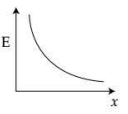
© examsnet.com
Go to Question: