Test Index
CBSE Class 12 Physics 2020 Outside Delhi Set 1 Paper
© examsnet.com
Question : 29 of 37
Marks:
+1,
-0
(a) Explain the principle of working of a potentiometer. (b) In a potentiometer, a standard source of emf 5 and negligible internal resistance maintain a steady current through the potentiometer wire of length . Two primary cells of emf and are joined together in a series with (i) same polarity and (ii) opposite polarity. The combination is connected to the potentiometer circuit in each case. The balancing length of the wire in the two cases are found to be and , respectively. Find the values of emf of the two cells.
Solution:
(a) Working principle of potentiometer: The Potentiometer is an electric instrument that used to measure the potential difference of a given cell and the internal resistance of a cell. It is also used to compare EMFs of different cells. The potentiometer consists of a long resistive wire having uniform cross-section and a battery of known emf . This voltage is called as driver cell voltage. Two ends of the resistive wire is connected to the battery terminals. This is a primary circuit arrangement. One terminal of another cell (whose emf is to be measured) is at one end of the primary circuit and another end of the cell terminal is connected to any point on the resistive wire using a jockey and a galvanometer . This arrangement is a secondary circuit. 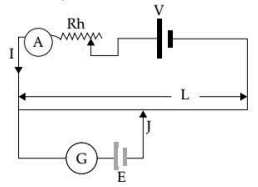 The basic working principle of this circuit is based on the fact that the potential drop across any portion of the wire is directly proportional to the length of the wire.If the current through the potentiometer is I and is the total resistance of the potentiometer, then .The resistivity and area of cross-section are constant. Also, the Current is kept constant using the rheostat. Now, the jockey is so adjusted that for length of the wire there is no current flow through the galvanometer.So, is known, is measurable by a scale. So, can be evaluated from the equation.When EMF of two cells are to be considered, then in the above similar way (b) Potential gradient When and are joined with same polarity, then .......(1) When and are joined with opposite polarity, then ......(2) Adding eqns (1) and (2) Subtracting eqn (2) from eqn (1)
© examsnet.com
Go to Question: