Test Index
CBSE Class 12 Physics 2020 Outside Delhi Set 1 Paper
© examsnet.com
Question : 35 of 37
Marks:
+1,
-0
SECTION - D
(a) Show that a current carrying solenoid behaves like a small bar magnet. Obtain the expression for the magnetic field at an external point lying on its axis. (b) A steady current of 2 A flows through a circular coil having 5 turns of radius . The coil lies in X-Y plane with its centre at the origin. Find the magnitude and direction of the magnetic dipole moment of the coil. OR (a) Derive the expression for the force acting between two long parallel current carrying conductors. Hence, define 1 A current. (b) A bar magnet of dipole moment rests with its centre on a frictionless pivot. A force is applied at right angles to the axis of the magnet, from the pivot. It is observed that an external magnetic field of is required to hold the magnet in equilibrium at an angle of with the field. Calculate the value of . How will the equilibrium be effected if is withdrawn?
Solution:
(a) Let us consider a solenoid, whose number of turns per unit length current passing through the solenoid . 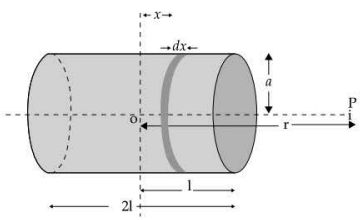 Let us consider a small element at distance from O.Magnetic field at (a point at a distance from ) is Integrating Putting .......(i) Now, magnetic moment, .......(ii)Putting in the eqn (i) The same magnetic field is produced by a bar magnet.Hence, a current carrying solenoid behaves like a bar magnet.(b) Magnitude of magnetic dipole moment with the circular current loop having number of turns, carrying a current and of area is . The direction of the magnetic dipole moment is perpendicular to the plane of the loop.Here Area Magnetic dipole moment OR(a) and are two straight very long parallel conductors, carrying currents and , respectively, separated by a distance .The magnetic induction due to current in at a distance is: ......(i)
 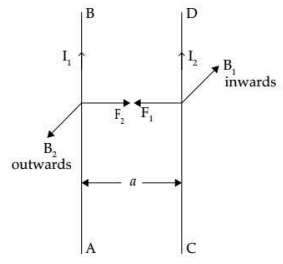 This magnetic field acts perpendicular to the plane of the paper and inwards. The conductor CD with current is situated in this magnetic field. Hence, force on a segment of length of due to magnetic field is .Substituting from eqn (i) ......(ii)By Fleming's Left Hand Rule, F acts towards left. Similarly, the magnetic induction due to current flowing in CD at a distance is ......(iii)This magnetic field acts perpendicular to the plane of the paper and outwards. The conductor with current , is situated in this field. Hence, force on a segment of length of due to magnetic field is Substituting from eqn (iii), ........(iv) By Fleming's Left Hand Rule, this force acts towards right. These two forces given in equations (ii) and (iv) attract each other. Hence, two parallel wires carrying currents in the samedirection attract each other and if they carry currents in the opposite direction, repel each other.Definition of 1 Ampere:The force between two parallel wires carrying currents on a segment of length is Force per unit length is If and ' ' Then, So, is defined as that constant current which when flowing through two parallel infinitely long straight conductors of negligible cross section and placed in air or vacuum at a distance of one meter apart, experience a force of . (b)
 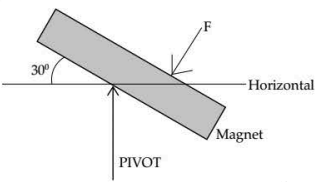 Dipole moment of the magnet force applied at a distance from the centreIt is now in equilibrium at an angle External magnetic field strength The magnet will be at rest when the total torque acting on it is 0 .It means that the torque due to applied force is equal to the torque due to magnetic force.Torque due to applied force Torque due to magnetic force Since, torque due to applied force torque due to magnetic force, so If is withdrawn, the magnet will go back to its original position.
© examsnet.com
Go to Question: